http://www.artinscotland.tv/2016/disinformation-the-analysis-of-beauty/
http://www.flickr.com/photos/disinfo/47923588897/
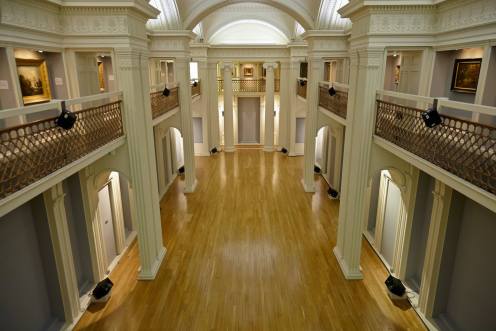
Art in Scotland and Summerhall TV made this video about the “The Analysis of Beauty” sound and video installation (see earlier post) which ran for 2 weeks, up to 29 Nov 2014, in the Georgian Gallery at Talbot Rice in Edinburgh. The actual sound featured in “The Analysis of Beauty” exhibit focussed on sine-waves with a core frequency of 40Hz, with the effect that (inevitably) the in-situ audio proved almost impossible to record for this video. For the most accurate representation of the gallery sound, please play the MP3 file below, listening through good quality external hi-fi loudspeakers or headphones (not laptop speakers).
As for the influence of William Hogarth’s ideas about “The Analysis of Beauty” and “Serpentine Line” etc, the evolution of this exhibit, which premiered at Kettle’s Yard gallery in 2000, is described in the Summerhall TV video. The installation also uses audio techniques employed in the Disinformation sound work “National Grid”, which was first performed and published in 1996 and first exhibited in 1997 (with further versions being performed, recorded and exhibited ever since). The precise audio specification for the installation at Talbot Rice is based on another Disinformation piece which employs the same technique – namely “Absolute Zero” – which was commissioned for the CD of the same name, by Japanese choreographer Saburo Teshigawara, and published by Charrm Records, also in 2000 (the audio clip embedded below is a short extract from that track, which was used as the sound demo for the installation at Talbot Rice; and if the audio skips, view this webpage using a different browser). For details of the illusions created by “The Analysis of Beauty” oscilloscope exhibit, see the “Rorschach Audio” book pages 161 to 175.
Special thanks to Martin Parker, James Clegg, Tommy Stuart, Pat Fisher, Stuart Fallon, Lucy Brown, Claire Hills, Zata Kitowski, Chris Orr, Richard Taylor, Ryan Van Winkle & Luci Wallace. Thanks to everyone who came to the symposium at Talbot Rice on 17 Nov. Thanks also to Nick Thurston for organising the (very well attended) “Rorschach Audio” talk in Leeds (see below), and to everyone who came along in Leeds as well.
“The Analysis of Beauty” by Disinformation
Talbot Rice Gallery
The University of Edinburgh
Old College
South Bridge
Edinburgh EH8 9YL
Reception + preview – 12.30 (lunch-time) 15 Nov 2014
Sound installation – 15 to 29 Nov 2014
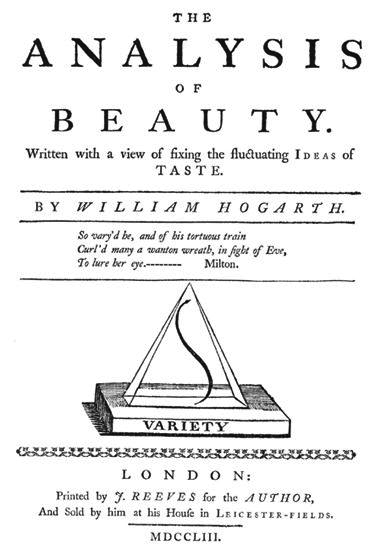
“The eye hath this sort of enjoyment in winding walks, and serpentine rivers, and all sorts of objects, whose forms, as we shall see hereafter, are composed principally of what I call the waving and serpentine lines. Intricacy in form, therefore, I shall define to be that peculiarity in the lines, which compose it, that leads the eye a wanton kind of chace, and from the pleasure that gives the mind, intitles it to the name of beautiful…” William Hogarth “The Analysis of Beauty” 1753
In 1753 the Georgian artist William Hogarth self-published his magnum-opus, “The Analysis of Beauty” – the book in which Hogarth expounded an aesthetic system based on analysing the virtues of the Serpentine, S-shaped, waving and snake-like lines. The Serpentine Line that William Hogarth discussed is identical to what modern nomenclature refers to as the sine-wave – the mathematical function whose geometry finds physical expression in oscillatory motion of musical strings, in pure musical notes, and in many phenomena of engineering, physics and communications science, signal processing and information technology.
In context of the architect William Playfair’s design for the Georgian Gallery at Talbot Rice, sonic and visual arts project Disinformation presents a minutely-tuned assemblage of pure musical sine-waves, which extend and extrapolate the visual aesthetics of Hogarth’s analyses, manifesting throughout the Georgian Gallery as a gently-hypnotic, immersive and dream-like sound-world. The installation is created using signals from laboratory oscillators, which manifest in-situ as standing-waves (the audio equivalent of stationary pond-ripples), through which visitors move as they explore and interact with the architectural acoustics of the exhibition space.
“The Analysis of Beauty” sound installation is accompanied at Talbot Rice by the video of the same name, in which musical sine-waves are fed into and displayed on the screen of a laboratory oscilloscope. These signals visually manifest as a slowly rotating rope-like pattern of phosphorescent green lines, strongly reminiscent of the geometry of DNA. This earliest version of “The Analysis of Beauty” installation was exhibited at Kettle’s Yard gallery in Cambridge, in 2000, where the Disinformation exhibit was set-up alongside works by Umberto Eco, Marc Quinn and the artist project Art & Language, and directly alongside one of Francis Crick & James Watson’s earliest working-models of DNA.
“The Analysis of Beauty” forms part of the “Gap in the Air” installation series at Talbot Rice, programmed by Dr. Martin Parker of The Edinburgh College of Art, in conjunction with Talbot Rice Gallery. “The Analysis of Beauty” runs at Talbot Rice simultaneous to “The Beguiled Eye” exhibition by the painter Christopher Orr. If you visit Talbot Rice, for the best sound, be sure to fully explore the upstairs (balcony) level of the Georgian Gallery.
https://digital.eca.ed.ac.uk/gap-in-air/2014/10/13/place/ [scroll down]
See “Rorschach Audio” book pages 161 to 175
Michael Palin is played by the Dectalk Express, John Cleese is played by the Intex Talker (Votrax SC-01A)
“Babylone Electrifiée” – Disinformation + Joshua Bonnetta
Video + Sound Installations
Continues until 22 Nov 2014
Le Bon Accueil – Lieu d’Art Contemporain
74 Canal Saint-Martin
35700 Rennes
France
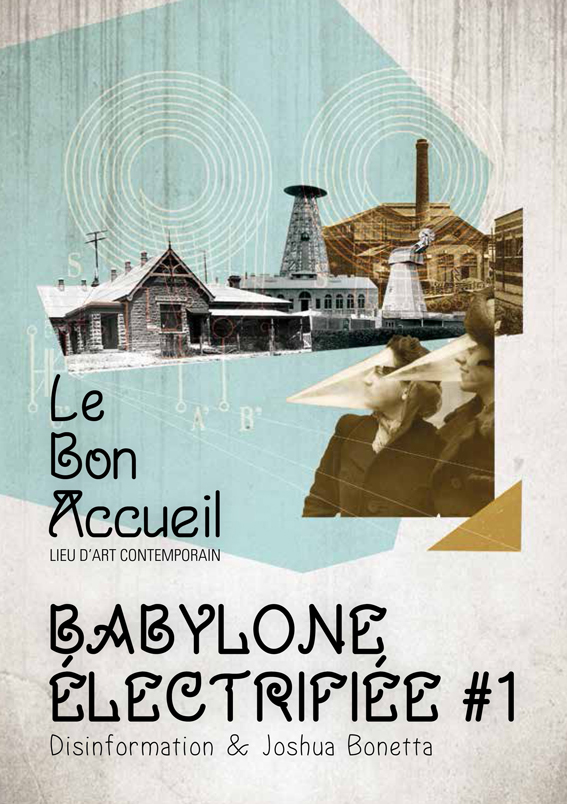
The “Babylone Electrifiée” exhibition [#1] features “National Grid” (electromagnetic noise from live mains alternating current), “The Analysis of Beauty” and “Blackout” (Sound Mirrors video) – all by Disinformation, plus “Strange Lines & Distances” by Joshua Bonnetta. Exhibition curated by Damien Simon.
Sound Mirrors 1997 – https://www.flickr.com/photos/disinfo/6896902030/
Sound Mirrors 1997 – http://www.discogs.com/viewimages?release=117617
http://bon-accueil.org/saison-2014-2015/ [scroll down]

Weds 22 Oct 2014, 2pm to 3.30pm
Lecture Theatre D
Chemistry Building
University of Leeds
Leeds LS2 9JT
Admission is free and the lecture is open to the public. The presentation is part of the Visiting Artist’s Talk series organised by The School of Fine Art, History of Art and Cultural Studies, University of Leeds.
Visiting speakers last year included Stelarc, David Batchelor and Penelope Curtis. Visitors this year include Jennifer Higgie, Sally Tallant and Grace Schwindt.
Almost as “postmodern” as the hidden messages in the You Tube videos of the Spongebob Squarepants theme-tune… REVERSED
Thanks to Simon Halsberghe for the heads-up!
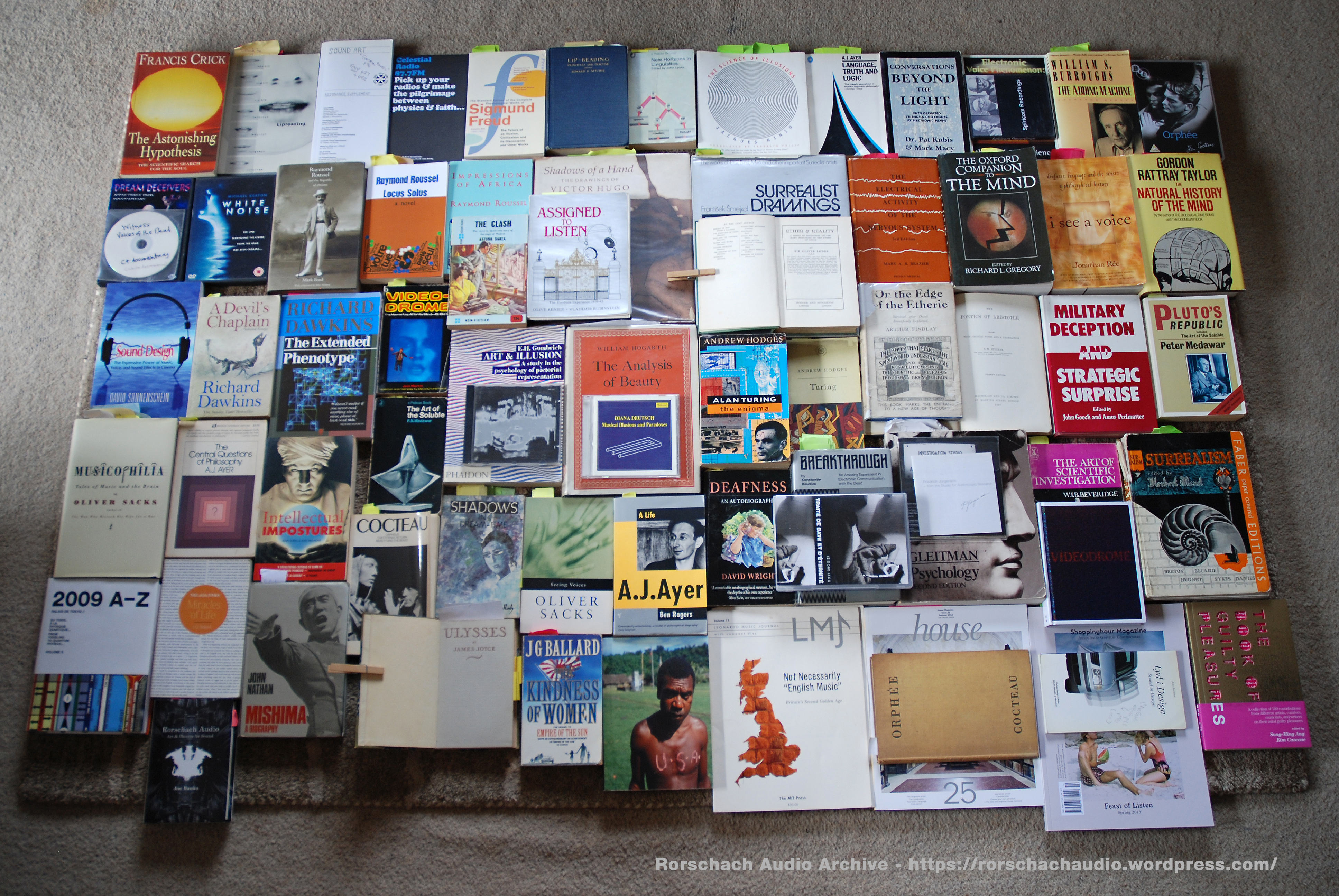
A selection of the hard-copy research materials used in the “Rorschach Audio” project (not including academic research papers or newspaper and magazine articles).
“Rorschach Audio” reviewed (in Dutch) in Gonzo Circus (Muziek, Kunst, Meer)…
https://www.gonzocircus.com/rorschach-audio/
 Disinformation + Rorschach Audio