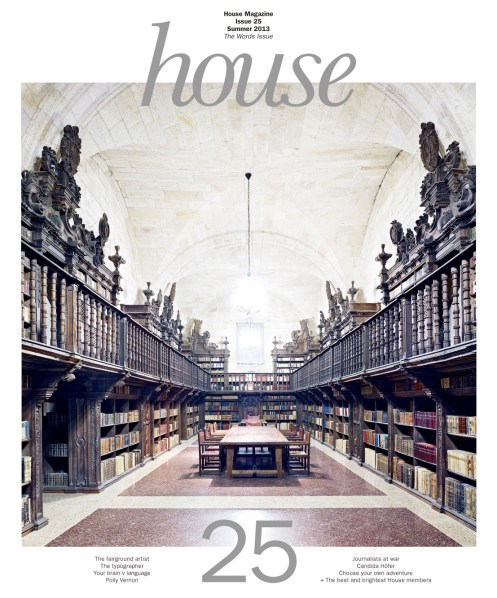
House Magazine, “Words” issue, number 25, contains an article on the “Rorschach Audio” project, featuring an interview conducted by Lore Oxford (alongside articles on and by Alison Carmichael, Bafic, Candida Höfer, Curtis Kulig, Damian Barr, Ewen Spencer, Four Corners Books, Francesca Gavin, Henrik Kubel, Ian Livingstone, Laura Bushell, Polly Vernon, Russell Thomas, Sarah Kim, Scott King, etc – special thanks by the way to Lore Oxford, Justin Quirk and Robin Mellor). The article was edited for length, so here’s the original Q&A (posted below), and, while the printed magazine’s been out for some time, the digital version’s just gone on-line now. Also Lara Cory, editor of the excellent Music Without Words & Fifteen Questions websites, posted an article inspired by the “Rorschach Audio” talk at The British Library, check ’em out…
Soho House magazine PDF (scroll down) – http://tinyurl.com/j52mysg
http://musicwithoutwords.com/2013/07/31/the-language-of-listening
LO: Please define your research and what you do with Rorschach Audio
JB: Most histories of audio recording technology start with early mechanical inventions – extraordinary machines like Édouard-Léon Scott de Martinville’s Phonautograph and Thomas Edison’s Phonograph etc, and, at the time of writing, Wikipedia for instance locates the prehistory of audio recording in early musical notation * – in musical scores, and in musical automata. It’s always possible someone’s going to improve the Wikipedia article, however, to paraphrase Aristotle’s “Poetics”, written languages – letters and words – are based on symbolic visual representations of indivisible sounds – so, firstly, all literature and poetry are forms of sound art, and secondly the earliest form of sound recording technology was not in fact a machine but was written language. If you consider letters and words as forms of technology, then the machine that reproduces the sounds those words represent is biological – it’s ourselves. In the human context the interpretation of sounds can be as imperfect as their reproduction, and the central metaphor here is that the way we interpret sounds has an imaginative aspect – the idea is that, particularly in noisy environments, we project meaning onto words and sounds in much the same way that viewers project images of faces, animals, ghosts, angels and monsters etc onto the symmetrical ink-blots famously used by the Swiss psychiatrist Hermann Rorschach. In fact, as the “Rorschach Audio” book points out, analogies between the interpretation of sounds and of ambiguous visual images go back at least as far as Leonardo da Vinci – what no-one seems to have done before this project was to try to address the full ramifications of those analogies, and it’s those ramifications that the Rorschach Audio project attempts to explore.
LO: What drew you to this subject matter?
JB: In the mid-1990s I started exhibiting sound art and recording electronic music under the name Disinformation, working primarily with radio recordings of electrical noise from sources like the sun, lightning and the National Grid. Within arts circles, there was and still is considerable interest in a form of parapsychology known as Electronic Voice Phenomena or EVP research, which is based on the idea that recordings of stray radio chatter – the usually very quiet and often highly distorted voices that occasionally intrude on tape recorders, PA systems and hi-fi equipment – are literally recordings of voices of ghosts. EVP research enjoys a significant cult following in the broader community and in the arts, with a number of very high profile contemporary artists exhibiting projects, which at worst take a totally credulous approach, at best an uncritical approach, to the factual claims made on behalf of EVP. “Rorschach Audio” started out as a series of lectures and articles which demonstrated how, ink-blot style, distorted and indistinct voice recordings can be mis-interpreted as being personally meaningful, and explained why EVP research isn’t scientific just because it makes use of technology. So, the original motive was to address misconceptions that were surprisingly commonplace in the arts, although since then the remit’s expanded considerably – ambiguities of hearing have had a significant influence on literature, and even on legal history for instance.
LO: Why did you chose to study the sensory perception of sound as opposed to the other senses?
JB: Legend has it that hi-fi sales personnel are trained to size-up customers in terms of whether they’re fundamentally a visually or a sound-oriented person, whether to sell them a hi-fi on the strength of its appearance, or on the strength of its sound, and I guess I’m slightly more sound-oriented. Other reasons are that, while there are literally thousands of books dealing with optical illusions and with psychology of visual phenomena etc, there are perhaps only a few hundred dealing with equivalent aspects of hearing, and when you consider that capital punishment for murder was abolished in the UK, in part because of disagreement about the interpretation of the words “Let him have it” in the Craig & Bentley shooting in 1952, and if you consider the importance of communicating clear speech in Air Traffic Control for instance, it seems clear that an informed understanding of the factors that influence hearing and mishearing can be extremely useful. Having said that, I also exhibit artworks which produce visual illusions.
LO: Are there any previous studies in this field, which inspired you to launch Rorschach Audio?
JB: There are hundreds, possibly thousands of scientific papers which deal with aspects of hearing like, for instance, the well-known Cocktail Party Effect. As most readers will probably be aware, it’s much easier to follow a conversation in a noisy social gathering, than it would be to follow the same conversation if it’s played-back from a tape recording. The difference is that during the party listeners make use of directional, sound-locating faculties to help isolate and extract a speaker’s voice from the surrounding hubbub, and also use an element of lip-leading; what people might not be aware of however is that the core research on the Cocktail Party Effect was sponsored by the American military, with a view to improving Air Traffic Control. “Rorschach Audio” cites alot of formal research, but also brings together a previously I believe unprecedented collection of anecdotal material, which describes similar phenomena playing-out in other real-world environments – from people hearing illusions of words in sounds of steam trains and ringing church-bells, to Surrealist author Raymond Roussel deliberately mishearing words as the basis for plotting his extraordinary novels. Probably the single most important source was a memo about interpretation of poorly-recorded voices that was circulated within the BBC department, that, during WW2, monitored foreign radio broadcasts for the War Office and for Winston Churchill etc. The author of that memo was BBC Monitoring Service supervisor Ernst Gombrich, and the understanding of psychology that he developed during WW2 had a critical influence on the book “Art & Illusion”, which Gombrich wrote in 1960, and which is arguably the most important work of visual arts theory ever published.
LO: What does the future hold for Rorschach Audio? Is their a specific goal you’re working towards?
JB: Rorschach Audio started-out as a not-for-profit, essentially zero-budget project, I went on to write-up one version of the research for an academically peer-reviewed journal published by The MIT Press, and, largely on the strength of that, The Arts & Humanities Research Council sponsored a 5-year research project at The University of Westminster and at Goldsmiths College. It’s always been an opportunity-driven project, however I’m always interested in exhibiting more Rorschach Audio artworks and it would be great to publish a more comprehensive version of the book, as there’s still a huge amount of as-yet unpublished research material.
LO: I heard that Noam Chomsky commented on Rorschach Audio?
JB: I sent The MIT Press article to the psychologist and author Steven Pinker, and to Noam Chomsky, the philosopher and linguist, followed by copies of the book. Steven Pinker described the project as “fascinating work” and Noam Chomsky described it as “intriguing”, which, even if he was just being polite, is pretty good considering he’s the most famous living philosopher in the world… I was very flattered just to get a reply. I also received a nice letter from Indu K Mallah, who’s a wonderful Indian author & tribal rights activist, quoted at some length in the book. Just working out how to contact her was a project in itself, which went as far as studying satellite photos on Google Earth to try to work-out her actual street address to send the book.
* This claim is still correct as of 14 Oct 2013
Finally thanks also to everyone who came to the Disinformation concert and “Rorschach Audio” talk at ERTZ#14 in Bera and Donostia (San Sebastian) in the Basque Country, and came to the performance at Portland Sculpture & Quarry Trust. Special thanks to Xabier Erkizia, Jose Luis Espejo, Mikel Nieto, Xavier Cejudo, Marcello Liberato and Natalia Barberi, and to Peter Lewis and Makiko Nagaya.

Play the clips in sequence (original audio from Disinformation + Various Artists “Antiphony” 2xCD, 1997; also scroll down for a more detailed article about art, illusions of sound, and Sine-Wave Speech, published in March 2013)…
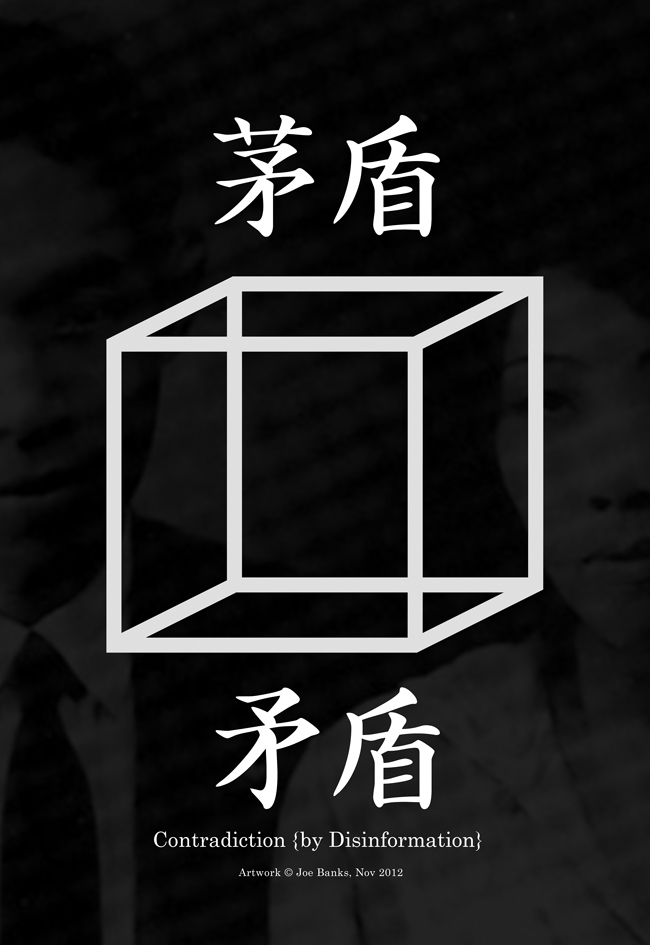
http://www.slashseconds.co.uk/disinformation/13/99/submission/contradiction/
Other contributors to Slash Seconds 13 include Paul Allsopp, Jonathan Allen, Anti-Design Festival, Myra Brooklyn, Simon Bedwell, Philippa Beale, Gail Burton, Sam Basu, Stephen Clarke, Sean Dower, Shezad Dawood, Poulomi Desai, Thomas Draschan, Véronique Janin Devoldère, Laura Emsley, Paul Eachus, Roy Exley, East End Promise, Anna Fasshauer, Nadine Feinson, Nooshin Farhid, Leo Fitzmaurice, Alison Gill, Derek Hampson, Alex Hamilton, Susie Hamilton, Michael Hampton, Paul Johnson, Susan Jahoda, Ben Judd, Arnout Killian, Daniel Kupferberg, Sue Kennington, Sharon Kivland, Katrin Lock & Tim Brotherton, Peter Lewis, Andrea Medjesi-Jones, Jo McGonigal, Simon Morse, Sadie Murdoch, Mark McGowan, Maslen & Mehra, Adam Nankervis, Makiko Nagaya, Nada Prlja, Janette Parris, David Price, Douglas Park, Clunie Reid, Hannah Roberts, Robyn Voshardt & Sven Humphrey, Hilary Koob-Sassen, Sergie Sviatchenko, Lisa Torell, Simon Tyszko, Cecilia Wee, Nathan Witt & James White. Special thanks to Peter Lewis & Makiko Nagaya.
“Portrait of Contradiction” by Disinformation, Artwork © copyright Joe Banks, November 2012 (see also earlier items posted in this on-line archive)

Many thanks to everyone who came along to (sold-out) talk at The British Library, and apologies to everyone who couldn’t get a ticket. The next “Rorschach Audio” lecture-demonstration will be for Café Scientifique in Leamington Spa…
“Rorschach Audio – EVP, Ghost Voice Recordings & Illusions of Science”
7.00pm, Monday 15 July 2013
Café Scientifique
St Patrick’s Irish Club
Riverside Walk (off Adelaide Road)
Leamington CV32 5AH
Writing in “Playback: The Bulletin of the British Library Sound Archive”, Toby Oakes observed that the archive “deals with the voices of the dead every day, but our subjects tend to have been alive at the time of recording”. “Mortality was no impediment” however, in the case of tapes recorded by parapsychologist Konstantin Raudive, who claimed that Galileo, Goethe and Hitler communicated with him through the medium of radio. Raudive was the most famous exponent of Electronic Voice Phenomena (EVP), as it is known, and the British Library holds a collection of 60 of his unedited tapes. Rather than dismissing the claims of EVP researchers out-of-hand, author Joe Banks demonstrates a number of highly entertaining audio-visual illusions, which show how the mind can misinterpret recordings of sound and of stray communications chatter, in a similar way to how viewers project imaginary images onto the random visual forms of the psychiatrist Hermann Rorschach’s famous ink-blot tests. The talk stresses the important role that intelligent guesswork plays in normal perception, and discusses descriptions of sound phenomena by Leonardo da Vinci, and the work of the BBC Monitoring Service, emphasizing the influence that wartime intelligence work with sound had on one of the most important works of visual arts theory every published.
The talk starts at 12:30 (however the library is a bit of a labyrinth so arrive 10 minutes early to make sure you find the scriptorium on time). Admission is free and refreshments are provided. To attend please e-mail your name to summer-scholars@bl.uk.
“Rorschach Audio – Ghost Voices, Art, Illusions and Sonic Archives”
12:30 lunch-time, 28 June 2013
The British Library
96 Euston Road
London NW1 2DB
This talk is part of the British Library’s Summer Scholars programme. Special thanks for Stephen Cleary for the invitation, and to everyone who came along to “Circuit Blasting” in Brighton.
 Disinformation + Rorschach Audio