Skip to content

Trebuchet Magazine review of “National Grid”

Trebuchet Magazine review of the “Noise & Whispers” exhibition at GV Art gallery in London (see earlier posts) – “Disinformation’s National Grid (is) one of the most important and impressive sound art works of recent times… this alone makes the exhibition worthwhile”…

http://www.trebuchet-magazine.com/noise-and-whispers/

Illusions of Thunder, and Sound Art as Mainstream Cultural Commodity

The following paragraphs served as the introduction and preamble to the presentation on “Sound Art as Mainstream Cultural Commodity”, given at the “What is Sound Design?” symposium, at The Edinburgh College of Art, 28 Nov 2013, and are in turn based on elements of the “Rorschach Audio” talk presented at the “Theatre Noise” conference, at The Central School of Speech & Drama, London, 23 April 2009. With apologies here to those readers who will be familiar with some of these arguments already, the introduction adds some important points – not least about what you might call the prehistory of contemporary sonic art. The following paragraphs were followed by an abridged version of the existing “Rorschach Audio” talk; then, in terms of delivering this talk’s political punch-line, followed by a series of videos which show how almost all the audio illusions demonstrated in the preceding talk are already known to and employed by creative artists, albeit artists who primarily operate within popular culture, as opposed to what’s conventionally thought of as being fine-art…

“There is a perception, particularly among contemporary art critics and arts commentators, but also among members of the public, that sound art is a relatively new art form. Of course the truth is that sounds produced by voices are among the earliest raw materials ever subjected to any form of creative manipulation. Speech itself is an art-form, and therefore poetry and literature of the oral tradition are, alongside music, the oldest forms of sound art, and probably the oldest art-forms. On that basis it can be argued that far from being a marginal or in any way “difficult” art-form, sound art is instead the most primal, the most pervasive, and arguably the earliest form of creative art. The argument put forward in my book “Rorschach Audio” is that, paraphrasing Aristotle’s “Poetics”, since written language is based on symbolic visual representations of indivisible sounds, the earliest form of sound recording technology was not, as is generally presumed, any form of machine, but was in fact written language. Alongside poetry and literature of the oral tradition, even written literature and poetry are therefore forms of sound art. So, when one considers music, poetry, literature, theatrical dialogue, theatrical sound effects and architectural acoustics, and particularly also sound design for contemporary cinema and computer games, it can be argued that, in its various diverse and widespread manifestations, sound art is one of, if not the, most mainstream and commercially important of cultural commodities.

By way of illustration, the art of designing theatrical sound effects is for instance quite clearly a form of sound art, which goes back at least as far as those architects whose expertise ensured that the proverbial pin could be heard dropping throughout the auditoria of ancient Greek amphitheatres. As regards specifically British history, the theatrical historian Robert Mott describes how since as long ago as “Shakespearian days” a “popular” method for simulating thunder sounds in theatre involved using “a cannon-ball rolling down a trough and falling onto a huge drum”. Robert Mott states that “some people were not pleased with this cumbersome technique”, so, in 1708, the theatre critic and dramatist John Dennis designed a thunder effect for his play “Appius & Virginia” at Drury Lane. John Dennis “invented something more realistic and controllable – a large piece of thin copper sheeting suspended from a frame by wires”. “The thunder sheet was a great success, and as a result other stage productions began using his effect. This infuriated Dennis to the point where he would angrily confront the offending producer by charging ‘you, Sir, are stealing my thunder!’.” Dennis is also said to have stated that “that is my thunder, by God; the villains will play my thunder, but not my play”. What this anecdote provides is not just another example of “early” sound art – of sonic art that predates contemporary fine-arts practice by 200 years – but also potentially the earliest recorded instance of what amounts to an intellectual property dispute between sound artists. This dispute was in fact so important that the phrase “stealing my thunder” has, for hundreds of years, been immortalised as common usage in no less than the English language.

The fact that, despite such histories, sonic art is not generally perceived to be a mainstream art-form, has arguably a great deal to do with phenomena of psychology of perception, and it is the psychology of perception of audible speech which forms the central focus of the book I’ve mentioned – “Rorschach Audio”. “Rorschach Audio” starts as a critique of so-called Electronic Voice Phenomena research. EVP is a belief system, whose adherents believe they’re able to literally record the voices of ghosts; and, as the demonstrations I’m about to present show, the misperception of stray radio and communications chatter as ghost-voices stems from misrepresentations of psychoacoustic phenomena. EVP practitioners misperceive voices they’ve recorded because those voices are sufficiently ambiguous, and because the beliefs EVP followers attach to them are sufficiently strong, to produce sound illusions which can be, if not objectively convincing, at least emotionally appealing. As well as demonstrating intriguing auditory phenomena, this talk is relevant to the sonic arts because so many, often high-profile, sound artists work with EVP, and because the ideas presented link to the individual generally recognised as the most important Western artist ever, and because they link to what is arguably the most important work of visual arts theory! I will now present a shortened version of the “Rorschach Audio” talk. Then, referring back to our theme of Sound Art as Mainstream Cultural Commodity, show as many examples as time permits of similar illusions to those discussed in “Rorschach Audio”, as they’re employed in mass-market mainstream popular arts culture.”…

Copyright © Joe Banks 2009 to 2013

Many thanks to everyone who came to the talks!
Zbigniew Karkowski, 1958 to 2013, R.I.P.

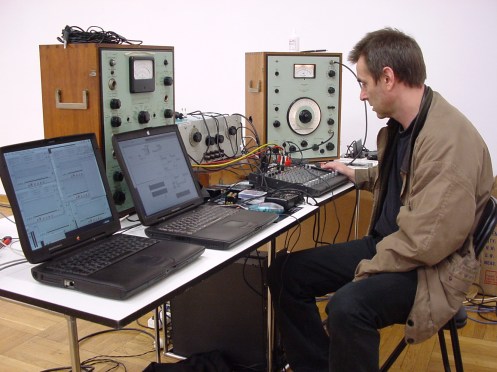
Noise composer Zbigniew Karkowski (who remixed Disinformation recordings for the “Antiphony” CDs and alongside whom Disinformation performed at the Observatori Festival in Valencia in 2009) has passed away, age 55. War against death!

“Rorschach Audio” talk + “National Grid” live in Edinburgh

“What is Sound Design?” is a three-day symposium at The University of Edinburgh, 27 to 29 Nov 2013. Rather than structuring the symposium around technologies, techniques and specific disciplines, the symposium categorises sounds in terms of duration. Day 1 explores sound on a micro-level, from samples to seconds. Day 2 moves from seconds to scenes. Day 3 scales-up from scenes to systems. Featuring a wide range of speakers and daily concert presentations, “What is Sound Design?” invites sonic artists, musicians, designers, scientists, engineers, theorists, composers, improvisers, performers, theatre sound specialists, directors, film makers, computer-games players and developers, graphic designers, historians, technologists, archaeologists, architects, acousticians, geographers and industrial designers to explore sound in terms pertinent to us all. Day 2 features a presentation which relates ideas explored in the “Rorschach Audio” project to the theme of “sound art as mainstream cultural commodity”. Day 2 features a concert by wild-life recording artist Chris Watson and expanded percussionist Christos Michalakos. Day 3 features a concert featuring Marco Donnarumma, Owen Green, Adam Linson, and “National Grid” by Disinformation. Check the website for details and registration –

http://www.soundesign.info/interviews/what-is-sound-design-symposium-at-the-university-of-edinburgh

http://digital.eca.ed.ac.uk/whatissounddesign/

“What is Sound Design?” features contributions from Joe Banks, Jamie Bullock, Pier Daniel Cornacchia, Richard Coyne, Annette Davison, Gordon Delap, Disinformation, Andy Farnell, Michael Gallagher, Ben Gillet, Owen Green, David Hendy, Adam Linson, Philippa Lovatt, Russell MacEwan, Craig Martin, Christos Michalakos, Peter Nelson, Sandra Pauletto, Jules Rawlinson, Michel Serres, Garry Taylor, Chris Watson, Simon Waters and Sean Williams, is organised by Martin Parker, Varun Nair and Owen Green, and generously supported by The Edinburgh College of Art at The University of Edinburgh and by New Media Scotland.

Dazed Digital feature on EVP

Readers visiting this website via the link in the Dazed Digital feature on Electronic Voice Phenomena by Stephen Fortune, the best place to start is the first article…

https://rorschachaudio.wordpress.com/2011/12/09/rorschach-audio-mit/

Anyone traveling in the opposite direction, go here…

http://www.dazeddigital.com/artsandculture/article/17729/1/electronic-voice-phenomena-ghosts?
Electricity, Power & the Politics of Listening

Without wishing to have any reader of this website jump to conclusions about this author’s ideological predispositions (or lack of them), Lenin is often quoted as having defined Communism as “Socialism plus electrification” (in fact The Guardian cites “The Oxford Dictionary of Political Quotations” as clarifying that Lenin stated “Communism equals Soviet power plus the electrification of the whole country”). Similarly, despite being the work of Conservative Prime Minister Stanley Baldwin, the Act of Parliament which inaugurated the UK’s National Grid in 1926 was described as “the most Socialist piece of legislation ever known”. So, in addition to the artist Ai Weiwei’s appropriation of the Chinese anti-government Cào Nǐ Mā mishearing (see earlier posts), and the “Rorschach Audio” project’s long-standing treatments of the politics of listening, if readers wish to relate the politics of listening to the politics of electrification (as referred to in texts accompanying Disinformation’s “National Grid” sound installations, etc), as contested in the field of sound and protest, then look no further than the spoken dialogue from soul-punk band The Redskins on the Channel 4 music TV show “The Tube” in 1984 (0:20 to 1:00 into the video).

In terms of the kinds of subject-matter discussed on this website, and in context of the pitched-battle that was (at that time) being fought between organised labour and Margaret Thatcher’s Conservative government, for what amounted to political control of the UK’s electrical infrastructure, the dialogue wasn’t so much ambiguous, the voice was almost totally inaudible (thanks to a highly political intervention by the Channel 4 producers). “On tambourine, on additional percussion, and on strike for 35 weeks, a Durham Miner…” (the voice of miner Norman Strike, from Westoe Colliery, South Shields). The “redacted” voice was subsequently re-recorded by Norman (for a cover-version of the original Redskins track by the band The Che Men). Play the audio file…

Norman Strike, Victory to the Miners

There’s been “Six miners killed in this strike, five miners on life-support machines, three miners with fractured skulls, over 2,500 serious injuries, and more than 7,500 arrests. We’re told we’re out on a limb, we’re on our own, that no-one supports us, yet hundreds of thousands of pounds have been collected for us by ordinary working-class people. Miners’ support groups have sprung up all over the country – in towns, factories offices and colleges. They’re supporting us. You should be supporting them. Victory to the miners!”

https://rorschachaudio.com/2013/10/24/gv-art-national-grid/

“Noise & Whispers” at GV Art, featuring “National Grid” by Disinformation

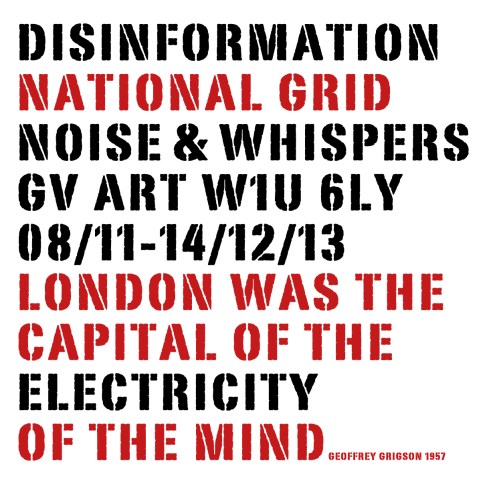
An installation version of the “National Grid” exhibit by Disinformation (see earlier posts) features in the “Noise & Whispers” exhibition at the GV Art Gallery in London, which runs from Fri 8 Nov to Sat 14 Dec 2013. Performance date/s TBC. If anyone fancies a swift ‘arf and a chat, please RSVP to info@gvart.co.uk to attend the opening reception. As the poet and wartime “ether-warrior” Geoffrey Grigson (who’s repeatedly quoted in the “Rorschach Audio” book) wrote in 1957, “London was the capital of the electricity of the mind”…

The GV Art Gallery
49 Chiltern Street
Marylebone
London W1U 6LY

https://www.gvart.co.uk/exhibitions-1/2017/6/19/noise-whispers-group-exhibition-from-8-november-14-december-2013

“Noise & Whispers” is curated by Martin A. Smith, thanks also to Robert Devcic. “Noise & Whispers” features artworks by Alex Baker, Bill Nelson, Blanca Regina, Clay Gold, Dan Tapper, Disinformation, Eléonore Pironneau, Iris Garrelfs, Jacqui Stewart, James Andean, Janek Schaefer, Jon Adams, Josh Horsley, Karen Gustafson, Kate Carr, Kevin Logan, Mark Peter Wright, Martin A. Smith, Matthias Kispert, Mendel Kaelen, Merja Nieminen, Random Order Collective, raxil4, Riz Maslen, Robin Storey, Simon Coates, Stephen Chase, Susan Alexjander, Susan Walsh, Thomas Finbarr, Thomas McConville, Wajid Yaseen, Yann Novak and Zahra Jewanjee.
Human Fiction Tartini sound-works featuring “National Grid” by Disinformation

Evanescent Continents

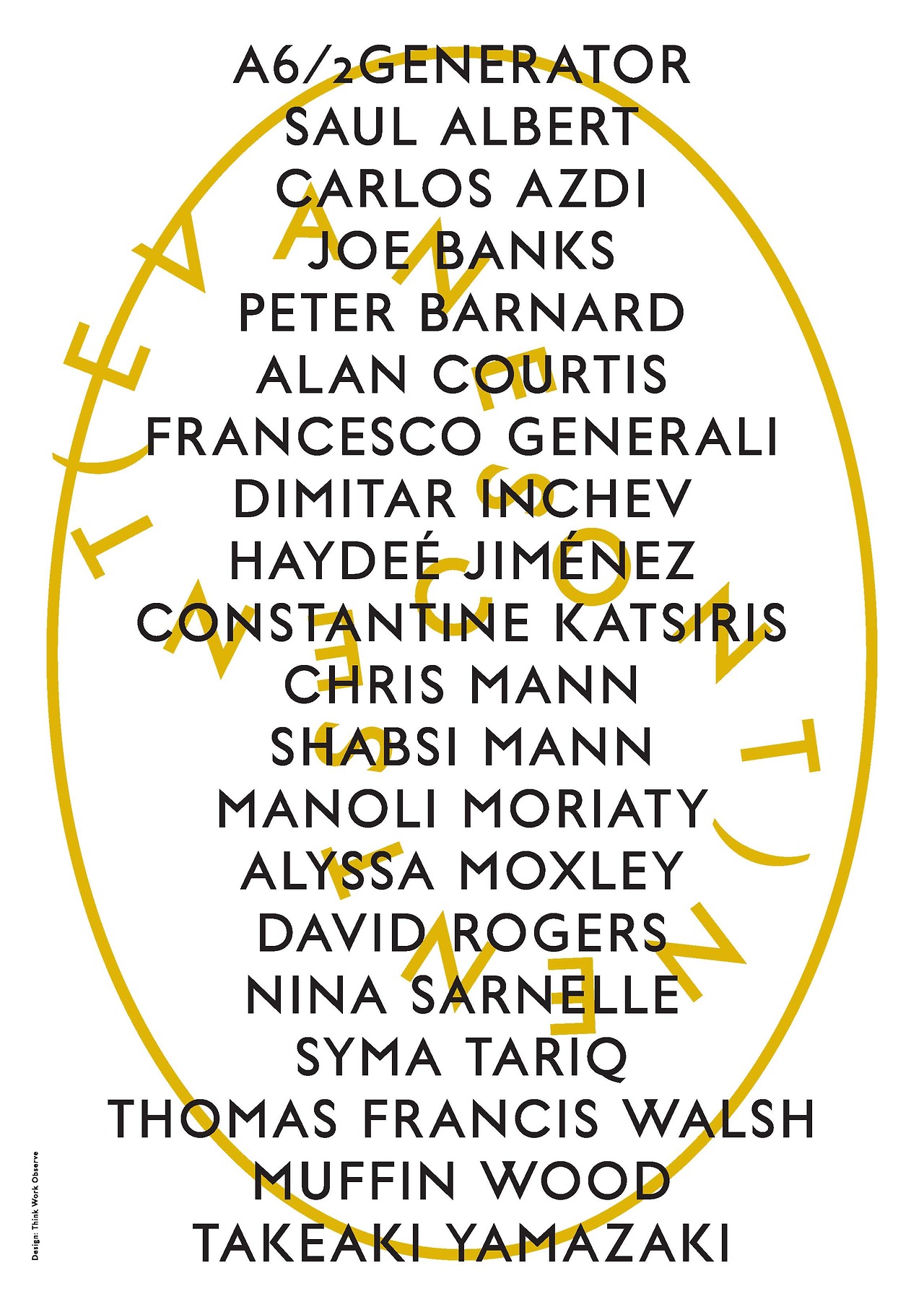
Evanescent Continents is a sound project by artists Mika Hayashi Ebbesen and Chris Wood, who remixed audio provided by several contributors for a listening event at X Marks the Bökship, in London on 17 Oct 2013. The event featured “Four Dreams” by Chris Wood and “Troll” by Mikatsiu, both including (the former more prominently) sounds from the “National Grid” sound artwork by Disinformation (although, owing to an error on my part, the poster – above – attributes the contribution to Joe Banks, instead of the preferred form of attributing to Disinformation).

The resonant frequency of mains Alternating Current is 50Hz, while the lowest “G” on the piano keyboard resonates at 49Hz. The “National Grid” sound artwork involves intercepting the 50Hz signal from live mains AC, then using electric guitar pedals to re-tune and re-combine the 50Hz fundamental with (depending on the tuning) for example 49Hz or 51Hz variants etc, producing the audio equivalent of visual moiré patterns, which transform the smoothly continuous low drone radiated by the city’s electrical infrastructure into a deeply musical, rhythmically pulsing sound mass (a similar tuning technique is referred to in classical music as “Tartini tuning”). “National Grid” was first performed live and published on LP in 1996, first exhibited as a gallery installation in London in 1997, and has been widely performed and exhibited ever since. See earlier posts for a discussion about relationships between electromagnetic sound art and issues of perception.

Both remixes are available to listen to on-line here…

http://human-fiction-tartini.tumblr.com/

The contributors to this Evanescent Continents project were A6/2 Generator, Saul Albert, Carlos Azdi, Joe Banks, Peter Barnard, Alan Courtis, Francesco Generali, Dimitar Inchev, Haydeé Jimenez, Constantine Katsiris, Chris Mann, Shabsi Mann, Manoli Moriarty, Alyssa Moxley, David Rogers, Nina Sarnelle. Syma Tariq, Thomas Francis Walsh, Muffin Wood and Takeaki Yamazaki. Thanks to Mika and Chris!

Soho House magazine & Music Without Words feature “Rorschach Audio”

House Magazine, “Words” issue, number 25, contains an article on the “Rorschach Audio” project, featuring an interview conducted by Lore Oxford (alongside articles on and by Alison Carmichael, Bafic, Candida Höfer, Curtis Kulig, Damian Barr, Ewen Spencer, Four Corners Books, Francesca Gavin, Henrik Kubel, Ian Livingstone, Laura Bushell, Polly Vernon, Russell Thomas, Sarah Kim, Scott King, etc – special thanks by the way to Lore Oxford, Justin Quirk and Robin Mellor). The article was edited for length, so here’s the original Q&A (posted below), and, while the printed magazine’s been out for some time, the digital version’s just gone on-line now. Also Lara Cory, editor of the excellent Music Without Words & Fifteen Questions websites, posted an article inspired by the “Rorschach Audio” talk at The British Library, check ’em out…

Soho House magazine PDF (scroll down) – http://tinyurl.com/j52mysg

http://musicwithoutwords.com/2013/07/31/the-language-of-listening

LO: Please define your research and what you do with Rorschach Audio

JB: Most histories of audio recording technology start with early mechanical inventions – extraordinary machines like Édouard-Léon Scott de Martinville’s Phonautograph and Thomas Edison’s Phonograph etc, and, at the time of writing, Wikipedia for instance locates the prehistory of audio recording in early musical notation * – in musical scores, and in musical automata. It’s always possible someone’s going to improve the Wikipedia article, however, to paraphrase Aristotle’s “Poetics”, written languages – letters and words – are based on symbolic visual representations of indivisible sounds – so, firstly, all literature and poetry are forms of sound art, and secondly the earliest form of sound recording technology was not in fact a machine but was written language. If you consider letters and words as forms of technology, then the machine that reproduces the sounds those words represent is biological – it’s ourselves. In the human context the interpretation of sounds can be as imperfect as their reproduction, and the central metaphor here is that the way we interpret sounds has an imaginative aspect – the idea is that, particularly in noisy environments, we project meaning onto words and sounds in much the same way that viewers project images of faces, animals, ghosts, angels and monsters etc onto the symmetrical ink-blots famously used by the Swiss psychiatrist Hermann Rorschach. In fact, as the “Rorschach Audio” book points out, analogies between the interpretation of sounds and of ambiguous visual images go back at least as far as Leonardo da Vinci – what no-one seems to have done before this project was to try to address the full ramifications of those analogies, and it’s those ramifications that the Rorschach Audio project attempts to explore.

LO: What drew you to this subject matter?

JB: In the mid-1990s I started exhibiting sound art and recording electronic music under the name Disinformation, working primarily with radio recordings of electrical noise from sources like the sun, lightning and the National Grid. Within arts circles, there was and still is considerable interest in a form of parapsychology known as Electronic Voice Phenomena or EVP research, which is based on the idea that recordings of stray radio chatter – the usually very quiet and often highly distorted voices that occasionally intrude on tape recorders, PA systems and hi-fi equipment – are literally recordings of voices of ghosts. EVP research enjoys a significant cult following in the broader community and in the arts, with a number of very high profile contemporary artists exhibiting projects, which at worst take a totally credulous approach, at best an uncritical approach, to the factual claims made on behalf of EVP. “Rorschach Audio” started out as a series of lectures and articles which demonstrated how, ink-blot style, distorted and indistinct voice recordings can be mis-interpreted as being personally meaningful, and explained why EVP research isn’t scientific just because it makes use of technology. So, the original motive was to address misconceptions that were surprisingly commonplace in the arts, although since then the remit’s expanded considerably – ambiguities of hearing have had a significant influence on literature, and even on legal history for instance.

LO: Why did you chose to study the sensory perception of sound as opposed to the other senses?

JB: Legend has it that hi-fi sales personnel are trained to size-up customers in terms of whether they’re fundamentally a visually or a sound-oriented person, whether to sell them a hi-fi on the strength of its appearance, or on the strength of its sound, and I guess I’m slightly more sound-oriented. Other reasons are that, while there are literally thousands of books dealing with optical illusions and with psychology of visual phenomena etc, there are perhaps only a few hundred dealing with equivalent aspects of hearing, and when you consider that capital punishment for murder was abolished in the UK, in part because of disagreement about the interpretation of the words “Let him have it” in the Craig & Bentley shooting in 1952, and if you consider the importance of communicating clear speech in Air Traffic Control for instance, it seems clear that an informed understanding of the factors that influence hearing and mishearing can be extremely useful. Having said that, I also exhibit artworks which produce visual illusions.

LO: Are there any previous studies in this field, which inspired you to launch Rorschach Audio?

JB: There are hundreds, possibly thousands of scientific papers which deal with aspects of hearing like, for instance, the well-known Cocktail Party Effect. As most readers will probably be aware, it’s much easier to follow a conversation in a noisy social gathering, than it would be to follow the same conversation if it’s played-back from a tape recording. The difference is that during the party listeners make use of directional, sound-locating faculties to help isolate and extract a speaker’s voice from the surrounding hubbub, and also use an element of lip-leading; what people might not be aware of however is that the core research on the Cocktail Party Effect was sponsored by the American military, with a view to improving Air Traffic Control. “Rorschach Audio” cites alot of formal research, but also brings together a previously I believe unprecedented collection of anecdotal material, which describes similar phenomena playing-out in other real-world environments – from people hearing illusions of words in sounds of steam trains and ringing church-bells, to Surrealist author Raymond Roussel deliberately mishearing words as the basis for plotting his extraordinary novels. Probably the single most important source was a memo about interpretation of poorly-recorded voices that was circulated within the BBC department, that, during WW2, monitored foreign radio broadcasts for the War Office and for Winston Churchill etc. The author of that memo was BBC Monitoring Service supervisor Ernst Gombrich, and the understanding of psychology that he developed during WW2 had a critical influence on the book “Art & Illusion”, which Gombrich wrote in 1960, and which is arguably the most important work of visual arts theory ever published.

LO: What does the future hold for Rorschach Audio? Is their a specific goal you’re working towards?

JB: Rorschach Audio started-out as a not-for-profit, essentially zero-budget project, I went on to write-up one version of the research for an academically peer-reviewed journal published by The MIT Press, and, largely on the strength of that, The Arts & Humanities Research Council sponsored a 5-year research project at The University of Westminster and at Goldsmiths College. It’s always been an opportunity-driven project, however I’m always interested in exhibiting more Rorschach Audio artworks and it would be great to publish a more comprehensive version of the book, as there’s still a huge amount of as-yet unpublished research material.

LO: I heard that Noam Chomsky commented on Rorschach Audio?

JB: I sent The MIT Press article to the psychologist and author Steven Pinker, and to Noam Chomsky, the philosopher and linguist, followed by copies of the book. Steven Pinker described the project as “fascinating work” and Noam Chomsky described it as “intriguing”, which, even if he was just being polite, is pretty good considering he’s the most famous living philosopher in the world… I was very flattered just to get a reply. I also received a nice letter from Indu K Mallah, who’s a wonderful Indian author & tribal rights activist, quoted at some length in the book. Just working out how to contact her was a project in itself, which went as far as studying satellite photos on Google Earth to try to work-out her actual street address to send the book.

* This claim is still correct as of 14 Oct 2013

Finally thanks also to everyone who came to the Disinformation concert and “Rorschach Audio” talk at ERTZ#14 in Bera and Donostia (San Sebastian) in the Basque Country, and came to the performance at Portland Sculpture & Quarry Trust. Special thanks to Xabier Erkizia, Jose Luis Espejo, Mikel Nieto, Xavier Cejudo, Marcello Liberato and Natalia Barberi, and to Peter Lewis and Makiko Nagaya.

Rorschach Audio + Disinformation at ERTZ #14!

Bertze Musiken Jaialdia / Festival de Otras Músicas
Irailak / 5-13 Septiembre 2013

The ERTZ festival features a Disinformation concert & “Rorschach Audio” lecture, also Maialen Lujanbio, Xabier Erkizia, Iban Urizar, Aitor Nova, Asier Gogortza, Jose Mari Zabala, Jose Luis Maire, Colin Hacklander, Farah Hatam, Idoia Zabaleta, Peter Cusack, Jakoba Errekondo, Fernando Mikelarena, Jose Luis Espejo, Mikel R Nieto, Luca Rullo, Eduardo Gil Bera, Karlos Sanchez Ekiza, ALKU / Roc Jimenez de Cisneros, Khantoria & Ander Berrojalbiz. Brochure, in Basque and Spanish –

http://www.eremuak.net/sites/default/files/hirugarren_belarria2013.pdf

https://hirugarrenbelarria.audio-lab.org