Skip to content

Gustav Metzger in conversation with Joe Banks…

“White Heat: art, science and social responsibility in 1960s Britain” is an exciting one-day conference exploring the relationships between art, science and society in the 1960s. 50 years on, key figures from this period will join speakers from the fields of art and cultural history, the history and philosophy of science, contemporary art, science, activism and popular culture to revisit one of the most intense periods of intellectual and cultural ferment. The symposium takes place in the very lecture theatre where, in 1965, Gustav Metzger gave his iconic lecture-demonstration “The Chemical Revolution in Art”.

Contributors include Joe Banks, Alice Bell, Jonathan Benthall, John Dunbar, Bronac Ferran, Elizabeth Fisher, David Gale, Martin Kemp, Nigel Lesmoir-Gordon, Roger Malina, Gustav Metzger, Jerry Ravetz, Jasia Reichardt, Jonathan Rosenhead, Neal White and Robert M. Young.

9.30am to 4pm, 26 July 2014
Lecture Theatre LT0
Department of Engineering
Trumpington Street
Cambridge CB2 1PZ

Admission £20, concessions £15
Advance booking essential

https://rorschachaudio.com/wp-content/uploads/2014/07/gustav_metzger_kettles_yard.pdf

Thanks to Bronac Ferran, Guy Haywood & Lizzie Fisher

https://rorschachaudio.com/2014/03/13/pink-floyd-the-wall-gustav-metzger/

https://rorschachaudio.com/2014/02/26/gustav-metzger-anti-university/

MUU Helsinki re-issue “MUU For Ears” CD…

The CD features a “Rorschach Audio” pastiche by Disinformation, also Gaia B, Alice Evermore & Eavesdropper, Incite/, Helena Gough, Sami Klemola, Charlie Morrow, Jean-Marc Savic & Sinebag – 2nd edition now available…

http://www.leppiniemi.net/MFE/MFE.html

AQNB reviews Rorschach Audio…

“Thought-provoking… fascinating” – http://wp.me/pwcbn-9Dj

John Locke on Illusions of Language…

“Vague and mysterious forms of speech, and abuse of language, have so long passed for mysteries of science; and hard or misapplied words with little or no meaning have, by prescription, such a right to be mistaken for deep learning and height of speculation, that it will not be easy to persuade either those who speak or those who hear them, that they are but the covers of ignorance and hindrance of true knowledge.” – John Locke (1632 to 1704)

See also – https://rorschachaudio.wordpress.com/2013/01/05/target-hypnosis/

And special thanks to International Times for plugging the book!

http://internationaltimes.it/rorschach-audio/

The Two Ronnies – Deaf In The Trenches

As EH Gombrich described, “It is the story of the signaller who misheard the urgent message ‘Send reinforcements, am going to advance’ as ‘Send three & four pence, am going to a dance’.” (see “Rorschach Audio” book, pages 22 to 26, etc).

Hack Circus podcast on “Rorschach Audio”

In conversation with Leila Johnston, 21 May 2014 – “All psychology experiments are artworks, and all artworks are psychology experiments…”

https://podcasts.apple.com/gb/podcast/hack-circus-transmission/id881932493?i=1000313382565

“Rorschach Audio” book on sale at the London Review Bookshop, Norman Records (Leeds), The Inkwell (York) and Ti Pi Tin (London)…

https://www.normanrecords.com/records/147665-joe-banks-rorschach-audio-art-illusion-for

Disinformation exhibition catalogue through Strange Attractor Press…

Disinformation R&D 1996

Featuring a critical essay by the art historian, curator and Wyndham Lewis biographer Richard Humphreys, “The Analysis of Beauty” is a profusely-illustrated, high-quality 204mm-square 48-page perfect-bound paperback, which documents the activities of the installation art and electronic music project Disinformation. Described by The Metro newspaper as “the black-ops unit of the avant-garde”, and by the author Hari Kunzru as (the) “poet of noise”, from 1995 onwards Disinformation began work on a program of research which led to a series of highly-influential and innovative LPs and CDs, which initially focussed on exploring the creative potential of recordings of electromagnetic (often VLF radio) noise phenomena – electrical interference from live mains electricity and electric storms, from the London underground, from industrial and IT hardware, and even the sun.

“The Analysis of Beauty” catalogue documents the evolution of Disinformation’s artistic strategies, including numerous concerts, gallery installations and solo exhibitions, also focussing on the title-exhibit (“The Analysis of Beauty” – which is named after the book by the artist William Hogarth), the “Spellbound” video installation (“An Allegorical Portrait of J. Robert Oppenheimer”), “Theophany” (“The Voice of God”), “National Grid” (sound from live mains electricity), “Stargate” (solar radio noise recordings), the “Rorschach Audio” research project, and Disinformation’s equally influential work at the abandoned village of Imber on Salisbury Plain, and documentation of the UK’s extraordinary coastal air-defence Sound Mirrors. The Guardian newspaper wrote that “Disinformation combine scientific nous with poetic lyricism to create some of the most beautiful installations around”.

http://strangeattractor.co.uk/shoppe/the-analysis-of-beauty/

“The ear, the organ of fear, could have evolved as greatly as it has only in the night and twilight of obscure caves and woods, in accordance with the mode of life of the age of timidity, that is to say the longest human age there has ever been… That is how music acquired the character of an art of night and twilight.” – Friedrich Nietzsche “Daybreak” 1881 (“The Analysis of Beauty” catalogue, page 38)
Disinformation performance with Peter Lewis & Makiko Nagaya

Rushgrove House

Events at Rushgrove House during Saturday, 31 May 2014, 2pm to 5pm –

2.30pm – Peter Lewis & Makiko Nagaya in collaboration with Disinformation
3.30pm – Talks by Peter Suchin, Byzantia Harlow & Zehra Arslan
4.30pm – Reading by Peter Lewis

Rushgrove House
Rushgrove Street
London SE18 5DD

Southeastern trains from London Bridge to Woolwich Dockyard – 20 mins; or Jubilee Line from Stratford to Canning Town, then DLR to Woolwich Arsenal – 20 mins.

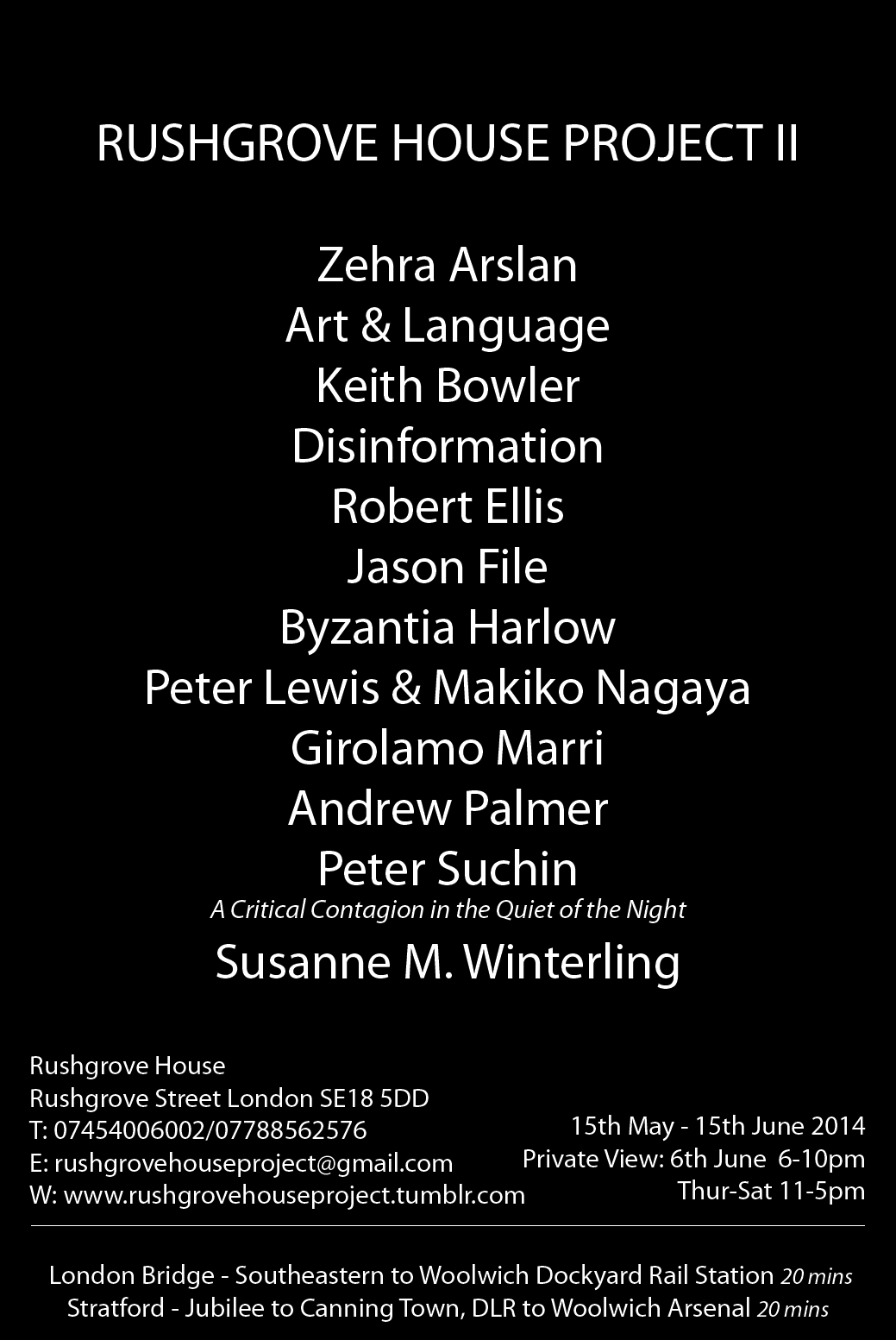
From 15 May to 15 June 2014, the ground floor of Rushgrove House features an exhibition of text artworks and journals by Art & Language, presented within a functioning artist project space. The project space hosts artists Zehra Arslan, Keith Bowler, Robert Ellis, Jason File, Byzantia Harlow, Peter Lewis & Makiko Nagaya, Girolamo Marri, Andrew Palmer and Susanne Winterling. The upper floor features “A Critical Contagion in the Quiet of the Night” – a retrospective by the artist and critic Peter Suchin (transferred from The & Model Gallery in Leeds) –

http://rushgrovehouseproject.tumblr.com/

The Spirit Voice of Sir Arthur Conan Doyle

Conan Doyle British Library

Article by Stephen Cleary, Lead Curator of Drama & Literature at The British Library (photo credit – The British Library)…

http://britishlibrary.typepad.co.uk/english-and-drama/2014/05/the-spirit-voice-of-sir-arthur-conan-doyle.html

Sigmund Freud, André Breton, Automatic Writing, Spirit Voices and EVP

Andre Breton

André Breton at the flea-market in Paris, photo by Gisèle Freund c.1955

I was recently lucky enough to come across the Atlas Press edition, translated by Antony Melville, of “The Automatic Message”, originally published in 1933 by the artist and poet André Breton – the founder of the Surrealist movement! André Breton’s essay offers what should provide some food-for-thought for those numerous (and sometimes famous and influential) artists who’ve opted to incorporate imagery of Spiritualism and of Electronic Voice Phenomena (ghost-voice) research into their work. Now, while the “Rorschach Audio” book notes that obvious precursors to contemporary EVP research existed in the form of Victorian Spiritualism, and that Spiritualist practices evolved into the modern EVP movement following a pretty-much smooth and continuous path, a major component of Victorian Spiritualism was the practice of automatic writing and automatic drawing, through which, in a manner similar to EVP recording, authors and artists were said to have communicated messages via direct mediumistic contact with the deceased. If we consider automatic writing and drawing to have been therefore more-or-less direct historic equivalents of technologically-mediated EVP recording, then Breton’s analysis stands in sobering contrast to those in contemporary art and music who in some cases promote literal belief in the alleged supernatural origin of EVP, or who adopt a stance of superficial and misleading neutrality while still perpetuating the myth that a bunch of (mostly) con-artists and charlatans were somehow “scientists”.

Sigmund Freud asserted that “the psychical origin of religious ideas” does not stem from “experience or (from the) end-results of thinking”, but from “illusions, fulfillments of the oldest, strongest and most urgent wishes of mankind”, and stated that “where questions of religion are concerned, people are guilty of every possible sort of dishonesty and intellectual misdemeanour”. In fact Freud’s book “The Future of an Illusion” then goes so far as to describe the results of Spiritualist research as “wretchedly meaningless”. André Breton’s essay is equally striking, not least in reminding us of the critical influence that automatic writing and drawing had on the formation and development of what was arguably one of the most important art movements of the entire 20th century, but more because Breton states that…

“Numerous samples of medium-based automatic writing which have from time-to-time been offered-up for examination have proved far less interesting than drawings purporting to have the same origin, and it must be said that this is largely the fault of the pathetic Spiritualist literature with which they have usually been contaminated from the outset. This kind of literature, as we know, has tended to proclaim vigorously, and try to gain acceptance for, the idea that the dictating element is external, in other words that “spirits” exist (clarity demands the use of this nauseating term). Medium draughtsmen have had their share of this unreasonable belief… but it is above all in writing that this pathetic joke has followed its degrading course… I would rather remain silent about efforts which are generally posited on a tainted basis, by which I mean that the hope of obtaining a communication from “the beyond” pre-exists the writing – of procuring the assistance of a great departed soul whose voice can be recognised by the tone of school recitation. These pieces indeed have nothing in common besides this emphatic tone and staggering level of naivety.” (pp.23-24)

In analysing the role that specific psychoacoustic illusions play in the misperception of sense-data such as EVP recordings, in therefore the transmission of EVP beliefs, and in a variety of other auditory and visual illusions, the “Rorschach Audio” book argues that the perceptual creativity demonstrated by our capacity to form such illusions emerged for very important reasons, as a result of evolutionary biology. The book argues that what these perceptual phenomena demonstrate is not evidence of supernatural activity, but evidence of underlying, intrinsic and in fact universal creative faculties, whose very existence subverts traditional, conservative thinking about the presumed supremacy of exclusionary “high culture” and “high art”.

It’s often forgotten just how intensely and intrinsically political the Surrealist movement was, and, as André Breton put it, “Surrealism’s achievement is to have proclaimed that all normal humans are completely equal in relation to the subliminal message, and to have maintained constantly that this message is a common heritage of which we can each have only to claim our share, and which must at all costs soon cease to be seen as the preserve of the few. Every man and every woman deserves the personal conviction that they themselves can, by right, have resource at will to this language, which is not in any way supernatural.” (p.26)

https://atlaspress.co.uk/product/andre-breton-paul-eluard-philippe-soupault-the-automatic-message/

Thanks to everyone who came along to Café Scientifique in Oxford, and special thanks to Dr Rachel Quarrell of Balliol College for the invitation.