
Raymond Roussel – sound artist, writer and theoretical biochemist (1877 to 1933)
See “Rorschach Audio” book pages 139 to 145
On February 19, 1989, a Boeing 747-249F operating as Flying Tiger Flight 66 was flying an international cargo flight from Singapore to Kuala Lumpur, Malaysia… ATC radioed to the flight, “Tiger 66, descend TWO four zero zero [2,400 ft]. Cleared for NDB approach runway three three”. The captain of Tiger 66, who heard “descend TO four zero zero” replied with “Okay, four zero zero” (meaning 400 ft above sea level, which was 2,000 ft too low)… the aircraft impacted a hillside 437ft above sea level, killing all four people on board; two pilots, a flight engineer and an aircraft mechanic. The fire burned for two days…
See “Rorschach Audio” book pages 21, 115, 116, 130 and 151
Probably the least trivial error to have found its way into the “Rorschach Audio” book appears on page 182, which should recommend that tinnitus sufferers should “not seek out excessive quiet”, but that they should instead try to “search for and create gently noisy environments”, by, for instance, (when preparing for sleep) “playing very quiet FM radio static or gentle white noise in the bedroom at night”. The correction here is the addition of the term “FM”, as FM radio static is more smoothly continuous and less troubled by interference, whereas AM static is much more prone to the kind of atmospheric electrical noise which may produce abrupt, unexpected sounds and possibly therefore wake-up listeners at night. Apologies for the mistake.
Also in relation to the same book, one point that’s been raised a couple of times now is the issue of whether or not the man who described himself as “The Great Beast 666” was (as the book says, on page 105) a “Satanist”? It goes without saying that the less than one half of one sentence that “Rorschach Audio” dedicates to Aleister Crowley could never really do justice to the broad sweep of any individual’s life, nonetheless, the following quotes should put the issue in perspective…
“I was not content to believe in a personal devil and serve him, in the ordinary sense of the word. I wanted to get hold of him personally and become his Chief of Staff” – The Confessions of Aleister Crowley, chapter 5, 1929
“I bind my blood in Satan, All that lieth betwixt my hands, To thee, the Beast, and thy control, I pledge me; body, mind and soul” – Aleister Crowley, Satanic Extracts
Another (small) error of omission that’s emerged is that a reference (on page 121) to a publication describing EVP research by Konstantin Raudive and Friedrich Jürgenson as work of (quote) “the scientist”, should be sourced as referring to page 3 of the “Calling All Agents” pamphlet by Tom McCarthy, published by The International Necronautical Society and Vargas Organisation (with funding from The Arts Council) in 2003. The pamphlet also documents contributions to the INS project from Jane Lewty, Heath Bunting, John Cussans, Zinovy Zinik, Manu Luksch, Mukul Patel and Cerith Wyn Evans. Even though much of the INS project was clearly intended to be tongue-in-cheek, nonetheless their booklet reveals underlying assumptions, and (as referred to on page 95 of the “Rorschach Audio” book) the sleevenotes to the Sub Rosa record label’s “Konstantin Raudive” CD also refer to the eponymous EVP researcher as “the Baltic scientist Konstantin Raudive” (emphasis added), but (as the book shows) there is nothing remotely “scientific” about any of the research conducted by Raudive or Jürgenson.
“I don’t try to make a mystery of things that are not a mystery…”
See “Rorschach Audio” book pages v, 23 to 27, 33, 51 to 58, 118 and 123
Documentary about EVP researcher Friedrich Jürgenson (in German)
See “Rorschach Audio” book pages 10 to 11, 46, 57, and 89 to 99
Suffice to say I’ve had much more important things to focus on in the last 5 years, predictably however, as soon as the “Rorschach Audio” book came out, it was groundhog day in terms of green-eyed monsters and their ill-informed gossip about “Rorschach Audio” (in fact, exactly the same gossip that the same individuals came out with some years ago). Oh, the joy of small ponds! It goes without saying that a project that applies genuinely critical analysis to a cherished belief, a belief that domestic appliances try to engage us in conversation (!) is going to attract hostility from people who are (how to put this politely?)… eccentric… and not always eccentric in the most charming of ways… so, readers should interpret any comments they find on-line in that light. Nonetheless, in the vain hope the following might encourage the trolls to get some perspective, my response is…
As regards the issue of whether the factual claims made by EVP and ghost-voice researchers are actually true or not, particularly in relation to the question of exploiting the bereaved, arguably the motives of EVP artists who prefer to remain neutral or to not express opinions about this, are even more questionable than those who openly support EVP (at least the genuine EVP believers are being honest). Rather than taking the opportunity to engage with any of Rorschach Audio’s substantive critique however, some individuals prefer to suggest that I criticise these artists because I’m jealous of their success. To set the record straight, I happily admit to having participated in a culture of healthy (intellectual and professional) competition among sound artists, and to being jealous of artists like Martin Creed (whose success I honestly believe is undeserved), but (even though I work very hard on my projects) I respect artists who’ve done well because they too work hard – there are plenty of them, and this book criticises no-one for being successful, it only criticises people for talking nonsense. The paradox is that if anything, far from being jealous, if only for practical reasons I am in fact grateful to those artists whose cynicism and/or gullibility with regard to EVP has given me, on a plate, way and ahead the most lucrative project I’ve ever undertaken! One extra point, that wasn’t made in the “Rorschach Audio” book, is that an alleged manipulation of audio recordings to create false hope that a dead person might have still been alive, was considered so unethical as to have made world-wide news and forced the closure of a national newspaper. Think about it.
The “Rorschach Audio” project’s criticisms of sound artists who try to dupe the public about the deceased have been made openly, over a long period; and, after years of working on “Rorschach Audio” for near zero personal gain, this project attracted considerable institutional support, because of, not despite, that track record. It was arguably because of, not despite, the fact that this book is going to be unpopular, in certain circles, that this project was deemed worthy of that level of support. As regards one specific critic, the accusation of jealousy is a classic example of negative projection – in other words, perhaps it’s you, as a music journalist and magazine editor, who is in fact jealous of this project’s success (sorry you didn’t get the editorial gig on the book). In addition to the gracious attentions of our green-eyed friends, the bottom line is that “Rorschach Audio” challenges fraudulent research that’s championed by dozens of musicians, artists and parapsychologists, so it’s inevitable some of them are going to try to get their own back, particularly by posting stupid comments about this book on-line.

Disinformation will be presenting Rorschach Audio and Rorschach Video material alongside a performance by painters Makiko Nagaya and Peter Lewis at the PARADISE EVENT – also featuring artists Judith Dean, Laura Emsley, Peter Fillingham, Kenneth Graham, Kate Janes, Rosemarie McGoldrick, Nicole Mollett, Charlotte Moth, Victor Mount, Sadie Murdoch, Francesco Pedraglio and Jamie Robinson – Walmer Parish Hall, Dover Road, Walmer, Kent CT14 7JH, Sunday 24 June, 2pm to 6pm. The Paradise event is curated by Peter Fillingham in association with The Elephant Trust, The Kent Cultural Baton, Rachael Daniels, Huc Malla and Laura White. By train – direct from London Cannon Street and London Bridge stations (the venue is an easy 10 minute walk from the station). By car – follow signs to Dover via A2, M20, then the A258 towards Deal.
“Banks’ works… add up to some of the most impressive audio research projects”
Rob Young (in “Sound Art – Sound as Media” NTT ICC Tokyo 2000, page 73)
Judging by the number of LPs and CDs whose sleeve-notes offer their apologies to “anyone we forgot”, mistakes like this are all too common, however that makes it no less embarrassing to have omitted acknowledgement for Dr Marq Smith in the “Rorschach Audio” book. Marq Smith is the director of The Institute for Modern & Contemporary Culture at The University of Westminster and founder of The Journal of Visual Culture, without Marq’s encouragement the “Rorschach Audio” project would not have been hosted by The University of Westminster, hence the book project would not have been brought to a successful conclusion. So, until an opportunity arises to thank Marq properly in print… thanks Marq… much appreciated!
The Skids “Into The Valley” (incidentally the first single I ever bought) & Desmond Dekker “The Israelites” (best available quality)… Enjoy!
See “Rorschach Audio” book page 86
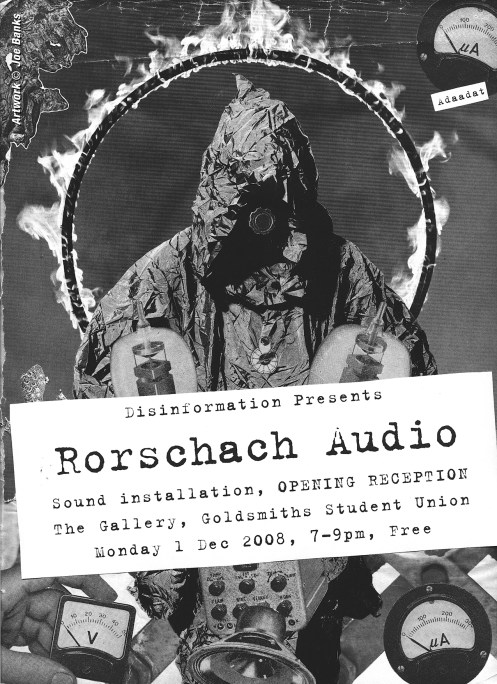
 Disinformation + Rorschach Audio