Skip to content

AT&T Technical Archives – Early Computer Graphics – The Talking Computer

“Speech synthesis at Bell Labs dates back to the 1930s and Homer Dudley’s Voder, which was exhibited and publicly demonstrated at the 1939 World’s Fair. Because understanding all aspects of the conversion of speech to electrical signal was a core interest of the Bell System, speech synthesis research continued at the company in the ensuing decades, entering the computer era in the 1960s, with articulatory speech vocal tract models created by Paul Mermelstein, Cecil Coker, John L. Kelly Jr., and Louis Gerstman, among others. Text-to-speech programs were researched from the 1960s all the way to the present day. This film specifically documents the output of an early text-to-speech program. Cecil Coker worked on this project, which is an articulatory synthesis program. Coker most likely first presented this film at… the 1967 M.I.T. Conference on Speech Communication and Processing, or the 1968 Processed Speech Symposium in Kyoto. Coker was also one of the scientists at Bell Labs involved with the E.A.T. collaborations with artists program; he added technical expertise to art performances by John Cage and Robert Rauschenberg.” – Footage and text, AT&T Archives & History Center, Warren, NJ.

Referring to the section of this recording that starts 1:14 into this video, in terms of further demonstrating how prior knowledge conditions perceptions of ambiguous sense-data, and, as with so-called Sine-Wave Speech experiments (see links below), when you hear Cecil Coker’s AT&T demonstration for the first time (please listen now before reading the rest of this paragraph), the speech comes across as almost completely unintelligible. When however you read the transcript that your author has painstakingly prepared (!) and then re-play the speech in the original sequence again, comprehension suddenly becomes much easier… “The North Wind and the Sun were arguing one day, when a traveller came along wrapped in a warm coat. They agreed that the one who would make the traveller take his coat off would be considered stronger than the other one. Then the North Wind blew as hard as he could, but the harder he blew, the tighter the traveller wrapped his coat around him. Then at last the North Wind gave up trying. Then the Sun began to shine hotly, and the traveller took off his coat immediately. And so the North Wind was obliged to confess that the Sun was the stronger of the two.”

See the reference to André-Marie Ampère – “Rorschach Audio” book page 154.

http://tinyurl.com/odrdrct

http://tinyurl.com/o24dbtr

http://tinyurl.com/ppfflwc

Disinformation in “Altered States” Film Programme

Disinformation will be featuring in “Altered States” – a programme of experimental film and video work, curated by filmmakers Toby Tatum and Mark French – at Electro Studios Project Space, St Leonards on Sea, 29 to 30 Aug 2015, and at Butlers Gap in Hastings on 5 Sept 2015…

http://coastalcurrents.org.uk/2016/altered-states/  [URL shows the wrong year]

“The Central Nervous System is Nature’s Sistine Chapel…”

J.G. Ballard, William Hogarth, Disinformation & the Serpentine Line…

Oscilloscope and video versions of the Disinformation installation “The Analysis of Beauty” are currently showing at the Freud Museum in London, as part of the “Festival of the Unconscious” exhibition, curated by Ivan Ward (scroll down for more details). The specific reference for this installation is to “The Analysis of Beauty” book, which was self-published by the artist William Hogarth in 1753, and particularly to Hogarth’s ideas about the aesthetics and symbolism of the sinusoidal, s-shaped, waving, snake-like, and (as Hogarth put it) “Serpentine Line”. Serpentine Lines are produced in “The Analysis of Beauty” installation in the form of musical sine-waves, using audio frequency outputs from laboratory oscillators, and then displayed on the screen of a laboratory oscilloscope. These signals manifest as a slowly rotating rope-like pattern of phosphorescent green lines, (subjectively but strongly) reminiscent of DNA. After watching the pattern for a little while, it’s easy to persuade these lines to fuse into a what appears to be a solid object, and, in practical terms, the best challenge viewers can set themselves is to decide which direction that object appears to be rotating in? Sometimes the form appears to be flat, sometimes three-dimensional. Sometimes the object rotates to the left, sometimes to the right. Sometimes the direction changes spontaneously… however blinking, tilting your head, and even thinking about the object in a different way can induce changes in the direction of rotation. None of the changes that viewers experience take place on-screen. All of these changes take place inside your own mind.

“The Analysis of Beauty” installation provokes the mind into creating illusions of three-dimensional visual form, despite the absence of all the object-precedence, motion-parallax, stereoscopic-binocular and geometric and aerial perspective cues traditionally thought to enable perception of visual space. As such the installation also relates to themes explored in Hogarth’s “Satire on False Perspective” of 1754 (see links). The installation demonstrates the formation of the “perceptual hypotheses” proposed by the physiologist Hermann Helmholtz, which the “Rorschach Audio” book characterises as the intelligent guesswork used by the mind to make sense of ambiguous stimuli that we encounter in the natural world. The changes produced by watching “The Analysis of Beauty” exhibit are essentially identical to the “perceptual flipping” discussed by evolutionary biologist Richard Dawkins in his book “The Extended Phenotype”. Video of this installation is also used during “Rorschach Audio” lectures to demonstrate visual equivalents of the audio illusions which the talks postulate as explaining misheard sound recordings such as EVP. In addition however, the method used to create “The Analysis of Beauty” exhibit strongly resembles imagery described in “The Sound Sweep” by sci-fi author J.G. Ballard (the “cathode tube” referred to here by J.G. Ballard is an oscilloscope, and the “tone generator” is a laboratory oscillator)…

“He twirled the ultrasonic trumpet he was playing, a tangle of stops and valves from which half a dozen leads trailed off across the cushions to a cathode tube and tone generator at the other end of the sofa. Mangon sat down quietly and Merrill clamped the mouthpiece to his lips. Watching the ray tube intently, where he could check the shape of the ultrasonic notes, he launched into a brisk allegretto sequence, then quickened and flicked out a series of brilliant arpeggios, stripping off high P and Q notes that danced across the cathode screen like frantic eels, fantastic glissandos that raced up twenty octaves in as many seconds, each note distinct and symmetrically exact, tripping off the tone generator in turn so that escalators of electronic chords interweaved the original scale, a multichannel melodic stream that crowded the cathode screen with exquisite, flickering patterns. The whole thing was inaudible, but the air around Mangon felt vibrant and accelerated, charged with gaiety and sparkle, and he applauded generously when Merrill threw off a final dashing riff… In his four years there his output of original ultrasonic music consisted of little more than one nearly finished symphony aptly titled Opus Zero.” J.G. Ballard, 1960

As regards the mind’s ability to, as demonstrated by such illusions, project meaning out into the world that we perceive, in “The Kindness of Women” J.G. Ballard also described a metaphor which suggests perception itself as the grandest act of artistic creativity… “The central nervous system is nature’s Sistine Chapel, but we have to bear in mind that the world our senses present to us – this office, my lab, our awareness of time – is a ramshackle construct which our brains have devised to let us get on with the job of maintaining ourselves and reproducing our species. What we see is a highly conventionalised picture, a simple tourist guide to a very strange city. We need to dismantle this ramshackle construct in order to grasp what’s really going on.” J.G. Ballard, 1992

This article is based on a talk given at Talbot Rice Gallery, Edinburgh, on 17 Nov 2014, while the J.G. Ballard quotes are also discussed in the “Rorschach Audio” book, pages 151 to 174. “The Analysis of Beauty” was most recently exhibited at Le Bon Accueil, Rennes, and at Talbot Rice.

http://rorschachaudio.com/2014/11/04/talbot-rice-edinburgh-disinformation/

http://rorschachaudio.com/2014/10/15/disinformation-joshua-bonnetta/

http://rorschachaudio.com/2012/07/10/william-hogarth/

http://rorschachaudio.com/2014/12/02/talbot-rice/

Article copyright © Joe Banks 2014-2015

Rorschach Audio workshop at MUMA, Melbourne

Rorschach Audio workshop at MUMA

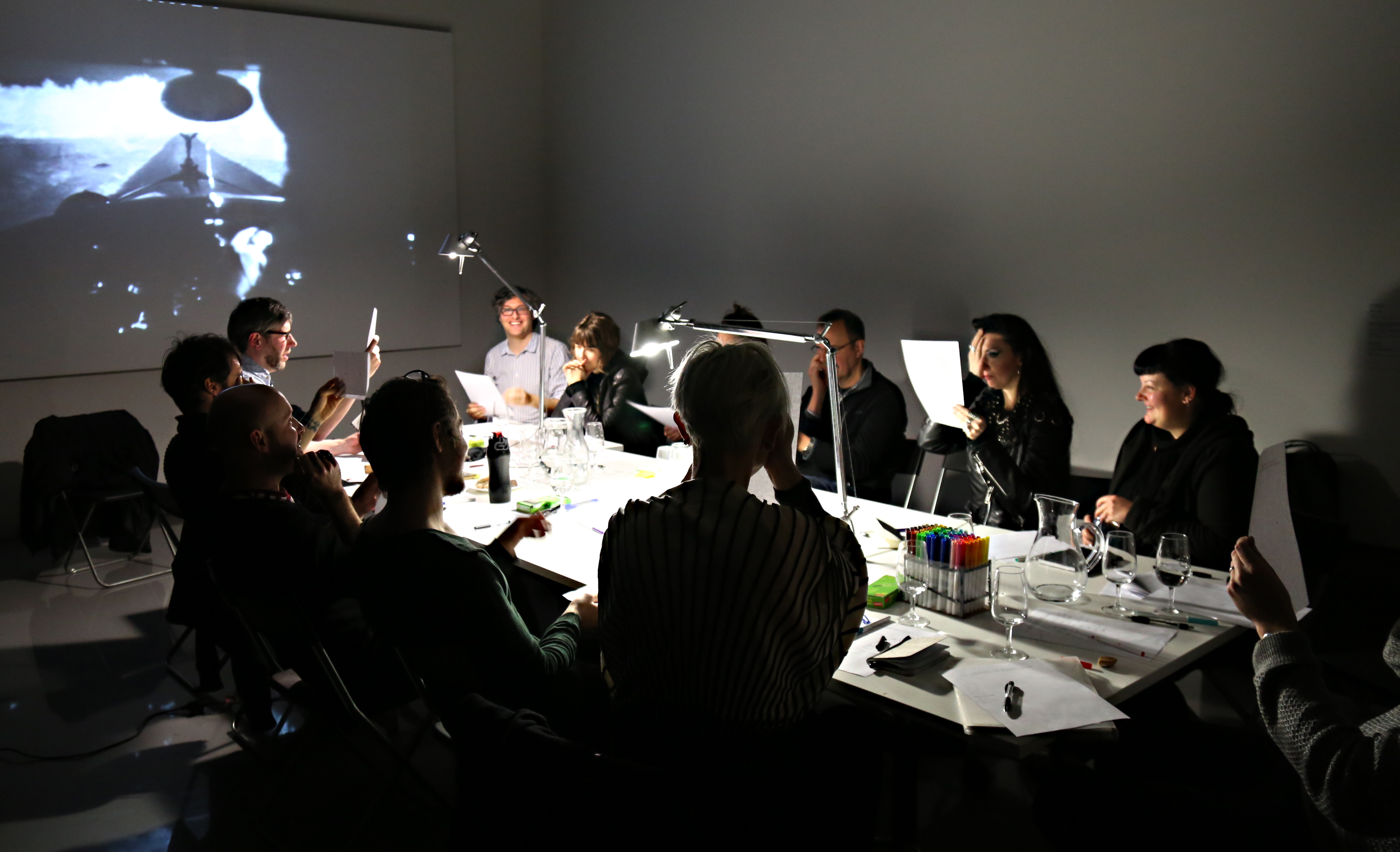
Participant worksheets from the Rorschach Audio post-lecture workshop, organised by Liquid Architecture at MUMA, Melbourne (photo by Anabelle Lacroix).

The image projected onto the screen in the back of this photograph is a scene from the film “Orpheus” by Jean Cocteau.

The Freud Museum presents “The Portrait of Jean Genet” video installation

As part of the “Festival of the Unconscious” exhibition, the Freud Museum presents “The Portrait of Jean Genet” by Disinformation. “The Portrait of Jean Genet” is a potentially infinite sound and video installation, based on the final interview given by the French burglar, prostitute and playwright Jean Genet, shortly before Genet’s own death. As a vivid articulation of the psychoanalytic concepts of Eros and Thanatos, Genet mishears the interviewer Nigel Williams, asking “Vous avez dit, L’Amour?” (“Did you say… Love”), because “J’ai entendu La Mort” (“I heard… Death”). In terms of “Rorschach Audio” type mishearings, the terms “L’Amour” and “La Mort” sound essentially identical, and are disambiguated by understanding their use in context. “The Portrait of Jean Genet” draws an analogy between the way in which listeners disambiguate perceptions of so-called “homophonic” sounds, and the way viewers project contradictory interpretations onto ambiguous visual figures, such as the spontaneously-reversing cube discovered by the Swiss crystallographer and geographer Louis Albert Necker.

“The Portrait of Jean Genet” is based on a static artwork of the same name, that was first published on the Flickr website in 2011, and then re-published in the book “Rorschach Audio” in 2012. “The Portrait of Jean Genet” video has been screened at PoetryFilm events at The ICA (London, 2014) & CCCB (Barcelona, 2015), and is exhibited with thanks to Alex Hammond, James Register, Claire Craig and to MOT International.

The “Festival of the Unconscious” exhibition also features “The Analysis of Beauty” and “Theophany” by Disinformation. “The Analysis of Beauty” is an oscilloscope exhibit which explores the artist William Hogarth’s concept of the Serpentine Line, and “Theophany” (The Voice of God) is an electromagnetic sound installation which lasts for exactly 0.083 seconds. The exhibition also features work by artist Julian Rothenstein (co-author of the best-selling “Psychobox”), “The Dream Collector” by artist Melanie Manchot, exhibits by Brass Art (featuring Monty Adkins), Sarah Ainslie and Martin Bladh, newly commissioned films by animators from Kingston University, an installation by stage designers from The Royal Central School of Speech & Drama, “The Unconscious Project” by practitioners from the MA Art Psychotherapy course at Goldsmiths College, performances by the artist Lili Spain and by poet Reveal, and a major conference with keynote speaker the psychoanalyst and neurosurgeon Mark Solms.

The Festival of the Unconscious
24 June to 4 October 2015
The Freud Museum
20 Maresfield Gardens
London NW3 5SX

https://www.freud.org.uk/exhibitions/festival-of-the-unconscious/

A “Rorschach Audio” lecture-demonstration also follows at The Freud Museum on July 23 – http://www.freud.org.uk/events/75970/rorschach-audio/

Many thanks to everyone who came to the capacity shows in Melbourne – apologies to those who couldn’t get in, and special thanks to Joel Stern, Liquid Architecture and Gertrude Contemporary, and to Francis Parker and all at MUMA Melbourne.

Boots and Cats! Speech Science for Fun & Profit!

In speech-science terms, the plosive “b” (“boot”) is misheard as representing the kick-drum, as used in the conventional organisation of a real or electronic drum-kit, while the hard “c” phoneme (“cat”) is misheard as representing hand-claps or possibly snare drums. I particularly like the way alveolar hissing sibilants (“boots n’ cats”) are used to represent the addition of hi-hats in the familiar style of an electronic house music or acid mix. As EH Gombrich observed (“Rorschach Audio” book, page 25) “we can read speech into a medley of noises”. In contrast the philosopher and cognitive scientist Jerry Fodor states in his (hugely influential) MIT Press book “The Modularity of Mind” (page 53) that “you can’t hear speech as noise even if you would prefer to”… although no doubt more difficult, in this instance that doesn’t seem to be case.

Thanks to Francis Parker for the heads-up!

Konstantin Raudive’s colleague Hans Bender…

A series of articles from Spiegel Magazine about Konstantin Raudive’s colleague and major supporter Hans Bender… it was Hans Bender in fact who Raudive quoted as stating that the importance of EVP is… (wait for it)… “equal to nuclear physics”!!!

http://magazin.spiegel.de/EpubDelivery/spiegel/pdf/42624470
http://www.spiegel.de/spiegel/print/d-42624470.html
“Parapsychology – Clairvoyant Scammers?”; 28 Jan 1959

http://magazin.spiegel.de/EpubDelivery/spiegel/pdf/46453115
http://www.spiegel.de/spiegel/print/d-46453115.html
“Parapsychology – Psi Fugitives”; 20 Feb 1967

http://magazin.spiegel.de/EpubDelivery/spiegel/pdf/40941986
http://www.spiegel.de/spiegel/print/d-40941986.html
“Affären – Dr Psi” (Business – Dr Psi); 28 Feb 1977

http://magazin.spiegel.de/EpubDelivery/spiegel/pdf/14021447
http://www.spiegel.de/spiegel/print/d-14021447.html
“Parapsychology – Controlled Zombie”; 22 Aug 1983

http://magazin.spiegel.de/EpubDelivery/spiegel/pdf/13488848 *
http://www.spiegel.de/spiegel/print/d-13488848.html
Hans Bender obituary; 13 May 1991 [*scroll down]

https://de.wikipedia.org/wiki/Das_Personenlexikon_zum_Dritten_Reich

https://en.wikipedia.org/wiki/Reichsuniversität_Straßburg

https://de.wikipedia.org/wiki/Hans_Bender_(Psychologe)

https://www.spiegel.de/politik/hans-bender-95-a-5c25bd43-0002-0001-0000-000135322544 [nb: paywall]

MUMA Melbourne & Gertrude Contemporary present Disinformation + Rorschach Audio

Hermann Rorschach - Rorschach Audio

Image [above]: Hermann Rorschach in 1921

Against the backdrop of “Believe not every spirit, but try the spirits” – an exhibition of and dedicated to the work of the Victorian Spiritualist painter Georgiana Houghton – Liquid Architecture and the Monash University Museum of Art are pleased to present British sound artist and writer Joe Banks in Australia for the first time. At Gertrude Contemporary, Joe Banks will deliver a lecture entitled “Rorschach Audio”, as part of the “Theories and Histories of Sound” series presented in association with Discipline. MUMA will also present a special concert by sonic arts project Disinformation as part of MUMA’s new “Sound Spaces” program…

Rorschach Audio – Lecture & Demonstration
Weds 3 June 2015
6:30pm to 8pm
Gertrude Contemporary
200 Gertrude St
Fitzroy VIC 3065
Australia

The talk will be followed by a short response from artist and researcher Ceri Hann (RMIT) before opening the floor to discussion

Disinformation – Concert
Thurs 4 June 2015
6:30pm to 8pm
Monash University Museum of Art | MUMA
Monash University Caulfield Campus
900 Dandenong Road
Caulfield East VIC 3145
Australia

Rorschach Audio – Discussion + Workshop
Sat 6 June 2015
3:00pm to 4:30pm TBC
Monash University Museum of Art | MUMA
Monash University Caulfield Campus
900 Dandenong Road
Caulfield East VIC 3145
Australia

“While other young artists were subscribing to Artforum, Joe was devouring journals on defence electronics and communications psychology…”

http://www.liquidarchitecture.org.au/artists/joe-banks/
http://www.gertrude.org.au/news/
http://tinyurl.com/zp3bq2u

Paul Nomex, 1968 to 2014, R.I.P.

Paul Nomex - photo copyright Jo Burzynska

Paul Nomex – photo courtesy Jo Burzynska

Googling information around the exhibition at The Auricle in New Zealand (see earlier post), I was devastated to learn about the death of pioneering noise DJ and sound artist Paul Nomex. From the mid to late 1990s Paul was a stalwart of the nascent South London noise scene, producing a series of ground-breaking releases on his Adverse record label, and contributing blinding sets to (among many others) the “Principles of Electronic Warfare” event that Disinformation programmed at The ICA (30 March 2000). Nomex and Disinformation also performed together at the (now defunct) 121 Centre in Brixton, at a Strange Attractor event at the Horse Hospital in Bloomsbury, and recorded a collaborative version of “National Grid” (intended to feature on an Adverse CD, but sadly never released). Paul was a real enthusiast and innovator, and was immensely amiable. Paul “Nomex” Kidd died in a motorbike crash near the Kawarau River in New Zealand in Feb 2014, sadly missed…

Paul Nomex, in his element – https://www.youtube.com/watch?v=XWacbGSFwHI

Rorschach Audio – Citations & References

A recent (though by no means complete) list of academic research papers that quote the version of “Rorschach Audio” that was published by The MIT Press in Leonardo Music Journal in 2001…

Michael Nees & Charlotte Phillips – “Auditory Pareidolia: Effects of Contextual Priming on Perceptions of Purportedly Paranormal & Ambiguous Auditory Stimuli”, Applied Cognitive Psychology, volume 29, issue 1, pages 129 to 134, Wiley 2015

Diana Espirito Santo – “Fluid Divination: Movement, Chaos & the Generation of Noise in Afro-Cuban Spiritist Oracular Production”, Anthropology of Consciousness, volume 24 issue 1, pages 32 to 56, American Anthropological Association 2013

Donna M. Lloyd, Elizabeth Lewis, Jacob Payne & Lindsay Wilson – “A Qualitative Analysis of Sensory Phenomena Induced by Perceptual Deprivation”, Phenomenology & the Cognitive Sciences, volume 11, issue 1, pages 95 to 112, Springer 2012

Jan Dirk Blom & Iris E.C. Sommer – “Akoestische Hallucinaties; Nomenclatuur en Classificatie”, Tijdschrift voor Psychiatrie, volume 53, issue 1, pages 15 to 25, Nederlandse Vereniging voor Psychiatrie 2011

Jan Dirk Blom & Iris E.C. Sommer – “Auditory Hallucinations; Nomenclature & Classification”, Cognitive & Behavioral Neurology, volume 23, issue 1, pages 55-62, Society for Behavioral & Cognitive Neurology 2010

Morley Hollenberg, Alan Dunning & Paul Woodrow – “Ghosts in the Machine”, Proceedings of the 16th ACM International Conference on Multimedia, pages 1125-1126, Association for Computing Machinery 2008

“Rorschach Audio” publications from 2001 and 2012 are also cited in the following books (“Anomalistic Psychology” being co-written by my former colleague, the excellent Prof. Chris French, Psychology Department, Goldsmiths College)…

Christopher French & Anna Stone – “Anomalistic Psychology: Exploring Paranormal Belief & Experience”, Palgrave Macmillan 2013

Greg Hainge – “Noise Matters: Towards an Ontology of Noise”, Bloomsbury Academic 2013

Tony Jinks – “An Introduction to the Psychology of Paranormal Belief and Experience”, McFarland 2011

Christof Migone – “Sonic Somatic: Performances of the Unsound Body”, Errant Bodies 2011

Jan Dirk Blom – “A Dictionary of Hallucinations”, Springer 2009

Mikko Keskinen – “Audio Book: Essays on Sound Technologies in Narrative Fiction”, Lexington 2008