“Talking to one’s fellow man in a language that he cannot understand may be a bad habit of some revolutionaries, but it is not at all a revolutionary instrument: it is… an ancient repressive artifice, known to all churches, the typical vice of our political class, the foundation of all colonial empires… He who does not know how to communicate, or communicates badly, in a code that belongs only to him and a few others, is unhappy, and spreads unhappiness around him. If he communicates badly deliberately, he is wicked or at least a discourteous person.”
– Primo Levi “On Obscure Writing”
“In all territories of thought which science or philosophy can lay claim to, including those upon which literature has a proper claim, no-one who has something original or important to say will willingly run the risk of being misunderstood; people who write obscurely are either unskilled in writing or up to mischief.”
– Peter Medawar “Science & Literature”
“At a time when superstitions, obscurantism and nationalist and religious fanaticism are spreading in many parts of the world… it is irresponsible, to say the least, to treat with such casualness what has historically been the principal defense against these follies, namely a rational vision of the world.”
– Alan Sokal & Jean Bricmont “Intellectual Impostures”
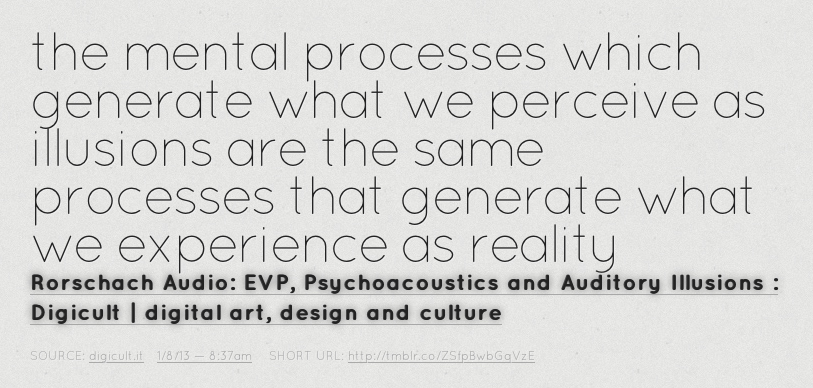
As attentive readers will by now be well aware, one thing the “Rorschach Audio” book does is to extend its’ discussion of illusions of sound into a discussion of illusions of language (and these illusions remain closely related, even in the case of written text, since, as the book points out, and as no less than Aristotle observed, written language is comprised of symbolic visual representations of indivisible sounds, and therefore the earliest form of sound recording technology was not, as is generally presumed, any kind of machine, but was in fact written language). The existence of linguistic illusions is alluded to, if not explicitly described, in the philosopher AJ Ayer’s assessments of the truth-value of metaphysical statements, however it’s a subject whose understanding is also important to contemporary sound art, and to an extent to contemporary politics and philosophy. As Werner Heisenberg put it, “human language permits the construction of sentences which do not involve any consequences and which therefore have no content at all” [1].
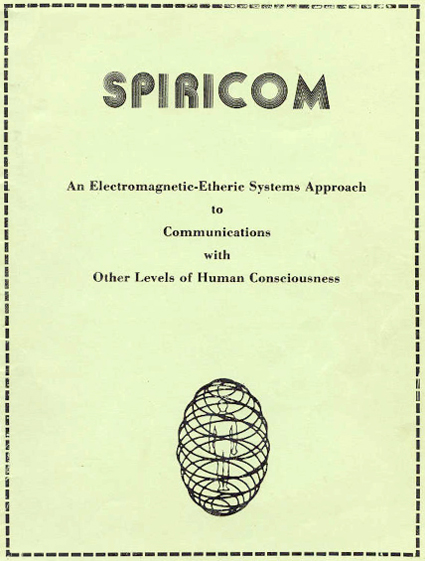
In the narrow field defined by even the most cursory glance at this book’s subject matter, namely the book’s treatment of audio illusions, the book describes the way ghost-voice researchers also employ the electronic recording, radio and laboratory technology that they use to record allegedly supernatural voice phenomena, to help conjure what amount to illusions of science, making an analogy with the forms of misdirection employed in similar fields by many contemporary artists (in short, researchers in parapsychology and in the arts often use the visual appearance of recording technology to create the illusion that frankly nonsense research is somehow scientific). Similarly, it’s also worth adding that the sound of superficially impressive pseudo-technical jargon, the sound of terms like Electronic Voice Phenomena and Instrumental Trans-Communication for instance, still (it seems) helps to dupe some people into at least reserving judgement about the claims made by EVP researchers like Konstantin Raudive. You could say it’s an issue of style versus content.
Also, in the broader (more philosophical) field defined by the book’s treatment of illusions of language, that problem remains relevant, relevant even to the field of art theory, because contemporary art writing suffers from an extreme form of target hypnosis that the biologist Peter Medawar identified as stemming from the “comically fallacious syllogism” that runs “profound reasoning is difficult to understand; this work is difficult to understand; therefore this work is profound” [2]. “The purpose of obscure or difficult writing is to create the illusion of profundity” [3], as exemplified by what Richard Dawkins termed “post-modern meta-twaddle” [4]. Contemporary art writing (and art itself) is absolutely full of it, so unfortunately is writing about sonic art (and, while one can’t blame postmodernist philosopher Gilles Deleuze for interpretations attached by people to his ideas after he died, nonetheless it comes as no surprise that art projects involving EVP have been defended on grounds that the same voice recordings that the artist Mike Kelley for instance admitted come across as (direct quote) “imbecilic” are as a result therefore also “positively contemporary” and therefore “Deleuzeian”) [5].
So, in context of EVP research and in the broader contexts of art and philosophy, illusions of language are used to try to blind members of the public with both bad science and with bad theory (readers are referred in particular to the numerous exposés of bad philosophy that were leveled against Gilles Deleuze, among others, by the mathematician Alan Sokal and the physicist Jean Bricmont for instance). Words themselves are weapons of sound, and, used as instruments of mystification and of social exclusion, willfully obscure and unnecessarily difficult writing is intrinsically ideological and inherently anti-democratic. Sokal and Bricmont point out that “the extreme focus on language and the elitism linked to the use of pretentious jargon contribute to enclosing intellectuals in sterile debates and to isolating them from social movements taking place outside their ivory tower”, and state that “rational thought and the fearless analysis of objective reality… are incisive tools for combatting the mystifications promoted by the powerful” [6]. Noam Chomsky argues that some intellectuals “seek to deprive working people of these tools of emancipation, informing us that… we must abandon the ‘illusions’ of science and rationality”, and asserting that their message “will gladden the hearts of the powerful” who will be “delighted to monopolize these instruments for their own use” [7].
So, in that context, and in marked contrast to much writing about contemporary sound art, the purpose of “Rorschach Audio” is not to flatter itself that it creates any self-consciously radical or difficult theory of anything. The book makes no apology for being a serious work deliberately written in an accessible style – its’ purpose is simply to help uncover and to communicate some aspects of the truth, and in doing so to help perform a kind of literary exorcism. To directly invert the philosophy proposed by EVP apologist William Burroughs, the ultimate message of this book is “Don’t Destroy All Rational Thought”.
Copyright © Joe Banks, 5 January 2013
[1] Werner Heisenberg “The Physical Principles of the Quantum Theory” Dover 1930
[2] Peter Medawar “The Art of the Soluble” Penguin 1969
[3] Peter Medawar “Pluto’s Republic” OUP 1984
[4] Richard Dawkins “Postmodernism Disrobed” Nature, 9 July 1998, vol. 394
[5] Mike Kelley “An Academic Cut-Up… or the New King of Pop: Dr. Konstantin Raudive” The Grey Room, No. 11, The MIT Press, Spring 2003
[6] Alan Sokal & Jean Bricmont “Intellectual Impostures” Profile 1998
[7] Noam Chomsky “Year 501: The Conquest Continues”, quoted in Sokal & Bricmont, op.cit.
http://www.physics.nyu.edu/sokal/dawkins.html
http://www.jstor.org/stable/1262621
http://mikekelley.com/academicut.html
http://xenopraxis.net/readings/kelley_raudive.pdf


 Disinformation + Rorschach Audio