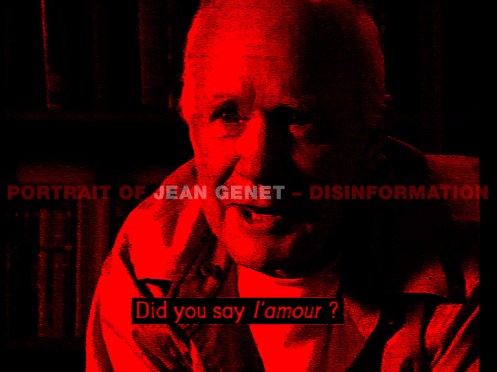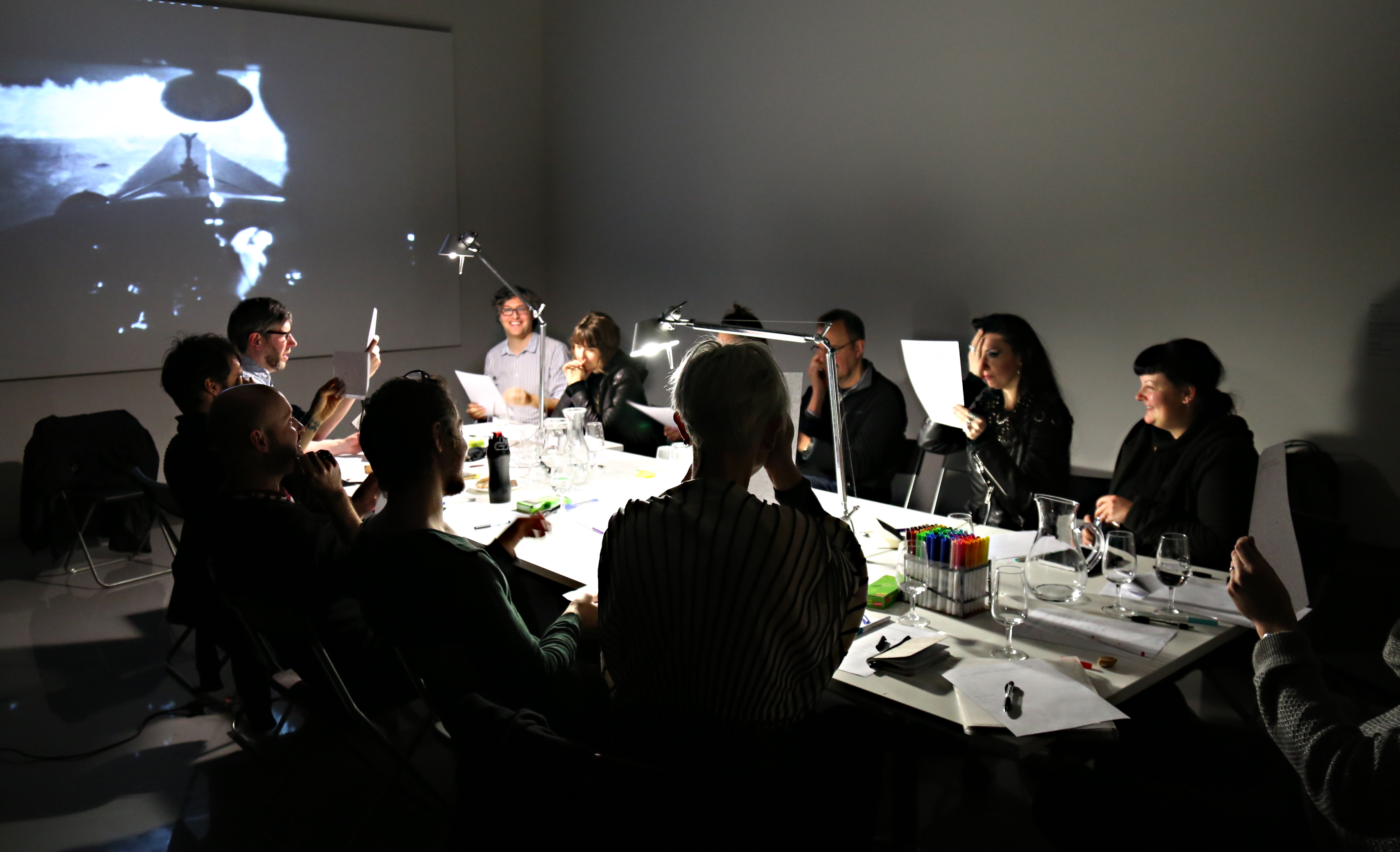
As part of the “Festival of the Unconscious” exhibition, the Freud Museum presents “The Portrait of Jean Genet” by Disinformation. “The Portrait of Jean Genet” is a potentially infinite sound and video installation, based on the final interview given by the French burglar, prostitute and playwright Jean Genet, shortly before Genet’s own death. As a vivid articulation of the psychoanalytic concepts of Eros and Thanatos, Genet mishears the interviewer Nigel Williams, asking “Vous avez dit, L’Amour?” (“Did you say… Love”), because “J’ai entendu La Mort” (“I heard… Death”). In terms of “Rorschach Audio” type mishearings, the terms “L’Amour” and “La Mort” sound essentially identical, and are disambiguated by understanding their use in context. “The Portrait of Jean Genet” draws an analogy between the way in which listeners disambiguate perceptions of so-called “homophonic” sounds, and the way viewers project contradictory interpretations onto ambiguous visual figures, such as the spontaneously-reversing cube discovered by the Swiss crystallographer and geographer Louis Albert Necker.
“The Portrait of Jean Genet” is based on a static artwork of the same name, that was first published on the Flickr website in 2011, and then re-published in the book “Rorschach Audio” in 2012. “The Portrait of Jean Genet” video has been screened at PoetryFilm events at The ICA (London, 2014) & CCCB (Barcelona, 2015), and is exhibited with thanks to Alex Hammond, James Register, Claire Craig and to MOT International.
The “Festival of the Unconscious” exhibition also features “The Analysis of Beauty” and “Theophany” by Disinformation. “The Analysis of Beauty” is an oscilloscope exhibit which explores the artist William Hogarth’s concept of the Serpentine Line, and “Theophany” (The Voice of God) is an electromagnetic sound installation which lasts for exactly 0.083 seconds. The exhibition also features work by artist Julian Rothenstein (co-author of the best-selling “Psychobox”), “The Dream Collector” by artist Melanie Manchot, exhibits by Brass Art (featuring Monty Adkins), Sarah Ainslie and Martin Bladh, newly commissioned films by animators from Kingston University, an installation by stage designers from The Royal Central School of Speech & Drama, “The Unconscious Project” by practitioners from the MA Art Psychotherapy course at Goldsmiths College, performances by the artist Lili Spain and by poet Reveal, and a major conference with keynote speaker the psychoanalyst and neurosurgeon Mark Solms.
The Festival of the Unconscious
24 June to 4 October 2015
The Freud Museum
20 Maresfield Gardens
London NW3 5SX
https://www.freud.org.uk/exhibitions/festival-of-the-unconscious/
A “Rorschach Audio” lecture-demonstration also follows at The Freud Museum on July 23 – http://www.freud.org.uk/events/75970/rorschach-audio/
Many thanks to everyone who came to the capacity shows in Melbourne – apologies to those who couldn’t get in, and special thanks to Joel Stern, Liquid Architecture and Gertrude Contemporary, and to Francis Parker and all at MUMA Melbourne.
In speech-science terms, the plosive “b” (“boot”) is misheard as representing the kick-drum, as used in the conventional organisation of a real or electronic drum-kit, while the hard “c” phoneme (“cat”) is misheard as representing hand-claps or possibly snare drums. I particularly like the way alveolar hissing sibilants (“boots n’ cats”) are used to represent the addition of hi-hats in the familiar style of an electronic house music or acid mix. As EH Gombrich observed (“Rorschach Audio” book, page 25) “we can read speech into a medley of noises”. In contrast the philosopher and cognitive scientist Jerry Fodor states in his (hugely influential) MIT Press book “The Modularity of Mind” (page 53) that “you can’t hear speech as noise even if you would prefer to”… although no doubt more difficult, in this instance that doesn’t seem to be case.
Thanks to Francis Parker for the heads-up!

A series of articles from Spiegel Magazine about Konstantin Raudive’s colleague and supporter Hans Bender… it was Hans Bender in fact who Raudive quoted as stating that the importance of EVP is… “equal to nuclear physics”!!
http://magazin.spiegel.de/EpubDelivery/spiegel/pdf/42624470
http://www.spiegel.de/spiegel/print/d-42624470.html
“Parapsychology – Clairvoyant Scammers?”; 28 Jan 1959
http://magazin.spiegel.de/EpubDelivery/spiegel/pdf/46453115
http://www.spiegel.de/spiegel/print/d-46453115.html
“Parapsychology – Psi Fugitives”; 20 Feb 1967
http://magazin.spiegel.de/EpubDelivery/spiegel/pdf/40941986
http://www.spiegel.de/spiegel/print/d-40941986.html
“Affären – Dr Psi” (Business – Dr Psi); 28 Feb 1977
http://magazin.spiegel.de/EpubDelivery/spiegel/pdf/14021447
http://www.spiegel.de/spiegel/print/d-14021447.html
“Parapsychology – Controlled Zombie”; 22 Aug 1983
http://magazin.spiegel.de/EpubDelivery/spiegel/pdf/13488848 *
http://www.spiegel.de/spiegel/print/d-13488848.html
Hans Bender obituary; 13 May 1991 [*scroll down]
https://www.spiegel.de/politik/hans-bender-95-a-5c25bd43-0002-0001-0000-000135322544 [nb: paywall]
https://de.wikipedia.org/wiki/Das_Personenlexikon_zum_Dritten_Reich
Image [above]: Hermann Rorschach in 1921
Against the backdrop of “Believe not every spirit, but try the spirits” – an exhibition of and dedicated to the work of the Victorian Spiritualist painter Georgiana Houghton – Liquid Architecture and the Monash University Museum of Art are pleased to present British sound artist and writer Joe Banks in Australia for the first time. At Gertrude Contemporary, Joe Banks will deliver a lecture entitled “Rorschach Audio”, as part of the “Theories and Histories of Sound” series presented in association with Discipline. MUMA will also present a special concert by sonic arts project Disinformation as part of MUMA’s new “Sound Spaces” program…
Rorschach Audio – Lecture & Demonstration
Weds 3 June 2015
6:30pm to 8pm
Gertrude Contemporary
200 Gertrude St
Fitzroy VIC 3065
Australia
The talk will be followed by a short response from artist and researcher Ceri Hann (RMIT) before opening the floor to discussion
Disinformation – Concert
Thurs 4 June 2015
6:30pm to 8pm
Monash University Museum of Art | MUMA
Monash University Caulfield Campus
900 Dandenong Road
Caulfield East VIC 3145
Australia
Rorschach Audio – Discussion + Workshop
Sat 6 June 2015
3:00pm to 4:30pm TBC
Monash University Museum of Art | MUMA
Monash University Caulfield Campus
900 Dandenong Road
Caulfield East VIC 3145
Australia
“While other young artists were subscribing to Artforum, Joe was devouring journals on defence electronics and communications psychology…”
http://www.liquidarchitecture.org.au/artists/joe-banks/
http://www.gertrude.org.au/news/
http://tinyurl.com/zp3bq2u

Paul Nomex – photo courtesy Jo Burzynska
Googling information around the exhibition at The Auricle in New Zealand (see earlier post), I was devastated to learn about the death of pioneering noise DJ and sound artist Paul Nomex. From the mid to late 1990s Paul was a stalwart of the nascent South London noise scene, producing a series of ground-breaking releases on his Adverse record label, and contributing blinding sets to (among many others) the “Principles of Electronic Warfare” event that Disinformation programmed at The ICA (30 March 2000). Nomex and Disinformation also performed together at the (now defunct) 121 Centre in Brixton, at a Strange Attractor event at the Horse Hospital in Bloomsbury, and recorded a collaborative version of “National Grid” (intended to feature on an Adverse CD, but sadly never released). Paul was a real enthusiast and innovator, and was immensely amiable. Paul “Nomex” Kidd died in a motorbike crash near the Kawarau River in New Zealand in Feb 2014, sadly missed…
Paul Nomex, in his element – https://www.youtube.com/watch?v=XWacbGSFwHI
A recent (though by no means complete) list of academic research papers that quote the version of “Rorschach Audio” that was published by The MIT Press in Leonardo Music Journal in 2001…
Michael Nees & Charlotte Phillips – “Auditory Pareidolia: Effects of Contextual Priming on Perceptions of Purportedly Paranormal & Ambiguous Auditory Stimuli”, Applied Cognitive Psychology, volume 29, issue 1, pages 129 to 134, Wiley 2015
Diana Espirito Santo – “Fluid Divination: Movement, Chaos & the Generation of Noise in Afro-Cuban Spiritist Oracular Production”, Anthropology of Consciousness, volume 24 issue 1, pages 32 to 56, American Anthropological Association 2013
Donna M. Lloyd, Elizabeth Lewis, Jacob Payne & Lindsay Wilson – “A Qualitative Analysis of Sensory Phenomena Induced by Perceptual Deprivation”, Phenomenology & the Cognitive Sciences, volume 11, issue 1, pages 95 to 112, Springer 2012
Jan Dirk Blom & Iris E.C. Sommer – “Akoestische Hallucinaties; Nomenclatuur en Classificatie”, Tijdschrift voor Psychiatrie, volume 53, issue 1, pages 15 to 25, Nederlandse Vereniging voor Psychiatrie 2011
Jan Dirk Blom & Iris E.C. Sommer – “Auditory Hallucinations; Nomenclature & Classification”, Cognitive & Behavioral Neurology, volume 23, issue 1, pages 55-62, Society for Behavioral & Cognitive Neurology 2010
Morley Hollenberg, Alan Dunning & Paul Woodrow – “Ghosts in the Machine”, Proceedings of the 16th ACM International Conference on Multimedia, pages 1125-1126, Association for Computing Machinery 2008
“Rorschach Audio” publications from 2001 and 2012 are also cited in the following books (“Anomalistic Psychology” being co-written by my former colleague, the excellent Prof. Chris French, Psychology Department, Goldsmiths College)…
Christopher French & Anna Stone – “Anomalistic Psychology: Exploring Paranormal Belief & Experience”, Palgrave Macmillan 2013
Greg Hainge – “Noise Matters: Towards an Ontology of Noise”, Bloomsbury Academic 2013
Tony Jinks – “An Introduction to the Psychology of Paranormal Belief and Experience”, McFarland 2011
Christof Migone – “Sonic Somatic: Performances of the Unsound Body”, Errant Bodies 2011
Jan Dirk Blom – “A Dictionary of Hallucinations”, Springer 2009
Mikko Keskinen – “Audio Book: Essays on Sound Technologies in Narrative Fiction”, Lexington 2008
“London – A Sonic Fragment”
The Auricle
35 New Regent St
Christchurch
New Zealand 8011
Exhibition dates – 5th to 28th Feb 2015
Opening event – 6pm 5th Feb 2015
From the official press release: “London – A Sonic Fragment” is an ambitious group show that brings together contemporary sound artists congregating in London, England. Despite tough living conditions, for artists especially, the capital still attracts and fosters a rich sound art scene. Their sonic concerns are varied as they are broad, travelling across spaces: galleries, nightclubs, squat parties, academic institutions and site specific work. “London – A Sonic Fragment” aims to provide a glimpse of the cross disciplinary activities and shifting terrain of sound art emanating from the UK capital. London’s vibrant scene is installed into and pouring out of The Auricle.
http://auricle.org.nz/london-a-sonic-fragment/
The exhibition is curated by sonic artist Justyna Burzynska, and features work by Shelley Parker, Disinformation, Graham Dunning, Greta Pistaceci, GPUD, Brown Sierra & Helen Frosi. The Disinformation artwork exhibited at The Auricle is “National Grid”, to quote from the website…
“National Grid” by Disinformation is a pioneering and highly influential sonic arts concept, first realised live and published on LP in 1996, first shown as a gallery installation in 1997, since exhibited at Kettle’s Yard, Fabrica, Le Bon Accueil and GV Art galleries, and performed at ZKM in Germany and London’s Hayward Gallery, etc. The legislation through which (Tory) Prime Minister Stanley Baldwin created Britain’s “National Gridiron” in 1926 was (ironically) described as “the most Socialist piece of legislation ever known”, and Lenin is said to have defined Communism as “Socialism plus Electrification”. The lowest G on a piano keyboard resonates at a fundamental frequency of 49Hz, while in the UK the sine-wave produced by Alternating Current resonates at 50Hz. “National Grid” manipulates direct outputs from live mains electricity, using a version of the microtonal tuning technique pioneered by the composer Guiseppe Tartini, to create a pulsing low-frequency sound mass, which is presented as a hypnotic and monolithic soundtrack to contemporary urban life, and as a sound-tribute to the creative genius of electrification.
Projected as part of the “Rorschach Audio” keynote at The University of Edinburgh, 28 Nov 2013 (see earlier posts)
See also – https://rorschachaudio.com/2012/12/15/phonemic-restoration/
http://www.artinscotland.tv/2016/disinformation-the-analysis-of-beauty/
http://www.flickr.com/photos/disinfo/47923588897/
Art in Scotland and Summerhall TV made this video about the “The Analysis of Beauty” sound and video installation (see earlier post) which ran for 2 weeks, up to 29 Nov 2014, in the Georgian Gallery at Talbot Rice in Edinburgh. The actual sound featured in “The Analysis of Beauty” exhibit focussed on sine-waves with a core frequency of 40Hz, with the effect that (inevitably) the in-situ audio proved almost impossible to record for this video. For the most accurate representation of the gallery sound, please play the MP3 file below, listening through good quality external hi-fi loudspeakers or headphones (not laptop speakers).
As for the influence of William Hogarth’s ideas about “The Analysis of Beauty” and “Serpentine Line” etc, the evolution of this exhibit, which premiered at Kettle’s Yard gallery in 2000, is described in the Summerhall TV video. The installation also uses audio techniques employed in the Disinformation sound work “National Grid”, which was first performed and published in 1996 and first exhibited in 1997 (with further versions being performed, recorded and exhibited ever since). The precise audio specification for the installation at Talbot Rice is based on another Disinformation piece which employs the same technique – namely “Absolute Zero” – which was commissioned for the CD of the same name, by Japanese choreographer Saburo Teshigawara, and published by Charrm Records, also in 2000 (the audio clip embedded below is a short extract from that track, which was used as the sound demo for the installation at Talbot Rice; and if the audio skips, view this webpage using a different browser). For details of the illusions created by “The Analysis of Beauty” oscilloscope exhibit, see the “Rorschach Audio” book pages 161 to 175.
Special thanks to Martin Parker, James Clegg, Tommy Stuart, Pat Fisher, Stuart Fallon, Lucy Brown, Claire Hills, Zata Kitowski, Chris Orr, Richard Taylor, Ryan Van Winkle & Luci Wallace. Thanks to everyone who came to the symposium at Talbot Rice on 17 Nov. Thanks also to Nick Thurston for organising the (very well attended) “Rorschach Audio” talk in Leeds (see below), and to everyone who came along in Leeds as well.
“The Analysis of Beauty” by Disinformation
Talbot Rice Gallery
The University of Edinburgh
Old College
South Bridge
Edinburgh EH8 9YL
Reception + preview – 12.30 (lunch-time) 15 Nov 2014
Sound installation – 15 to 29 Nov 2014
“The eye hath this sort of enjoyment in winding walks, and serpentine rivers, and all sorts of objects, whose forms, as we shall see hereafter, are composed principally of what I call the waving and serpentine lines. Intricacy in form, therefore, I shall define to be that peculiarity in the lines, which compose it, that leads the eye a wanton kind of chace, and from the pleasure that gives the mind, intitles it to the name of beautiful…” William Hogarth “The Analysis of Beauty” 1753
In 1753 the Georgian artist William Hogarth self-published his magnum-opus, “The Analysis of Beauty” – the book in which Hogarth expounded an aesthetic system based on analysing the virtues of the Serpentine, S-shaped, waving and snake-like lines. The Serpentine Line that William Hogarth discussed is identical to what modern nomenclature refers to as the sine-wave – the mathematical function whose geometry finds physical expression in oscillatory motion of musical strings, in pure musical notes, and in many phenomena of engineering, physics and communications science, signal processing and information technology.
In context of the architect William Playfair’s design for the Georgian Gallery at Talbot Rice, sonic and visual arts project Disinformation presents a minutely-tuned assemblage of pure musical sine-waves, which extend and extrapolate the visual aesthetics of Hogarth’s analyses, manifesting throughout the Georgian Gallery as a gently-hypnotic, immersive and dream-like sound-world. The installation is created using signals from laboratory oscillators, which manifest in-situ as standing-waves (the audio equivalent of stationary pond-ripples), through which visitors move as they explore and interact with the architectural acoustics of the exhibition space.
“The Analysis of Beauty” sound installation is accompanied at Talbot Rice by the video of the same name, in which musical sine-waves are fed into and displayed on the screen of a laboratory oscilloscope. These signals visually manifest as a slowly rotating rope-like pattern of phosphorescent green lines, strongly reminiscent of the geometry of DNA. This earliest version of “The Analysis of Beauty” installation was exhibited at Kettle’s Yard gallery in Cambridge, in 2000, where the Disinformation exhibit was set-up alongside works by Umberto Eco, Marc Quinn and the artist project Art & Language, and directly alongside one of Francis Crick & James Watson’s earliest working-models of DNA.
“The Analysis of Beauty” forms part of the “Gap in the Air” installation series at Talbot Rice, programmed by Dr. Martin Parker of The Edinburgh College of Art, in conjunction with Talbot Rice Gallery. “The Analysis of Beauty” runs at Talbot Rice simultaneous to “The Beguiled Eye” exhibition by the painter Christopher Orr. If you visit Talbot Rice, for the best sound, be sure to fully explore the upstairs (balcony) level of the Georgian Gallery.
https://digital.eca.ed.ac.uk/gap-in-air/2014/10/13/place/ [scroll down]
See “Rorschach Audio” book pages 161 to 175