An article called “Pulse Shape 22: Audiovisual Performance and Data Transmutation” by media artist Mark Cetilia has just been published in Leonardo, Volume 49, Number 4, 2016, pp. 317-323. The article describes “an improvisational audiovisual performance featuring shortwave radio transmissions as the sole source material for real-time audio processing alongside video of the sun” – a performance whose structure is “derived from metrics on energy accumulation over a period of 2.2 nanoseconds resulting from the targeting of 60 laser beams on a single tetrahedral hohlraum in weapons testing experiments as carried out by the Los Alamos Inertial Confinement Fusion unit”… wow! The performance sounds astonishing, and, although linking such ideas to EVP may sound equally extraordinary, in fact Mark Cetilia states that “though I am not looking to communicate with the dead, the concerns of my artistic practice are somewhat analogous to the concerns of the EVP community” since “I not only carefully scrutinize the radio noise I use as raw sonic material… (and) I also look for ways to make meaning from this material”, hence the relevance of quoting “Rorschach Audio”. The article states that…
“Belief in EVP has become widespread since (Friedrich) Jürgenson’s time, and with the advent of the internet, numerous groups and forums have appeared wherein users trade tips on how best to capture these recordings. Joe Banks… has, in Rorschach Audio, framed EVP as sound recordings whose existence is “as relevant to the emergent field of sound art as studies of optical illusions have been to the study of visual art” (with Mark’s article citing the version of “Rorschach Audio” that was published in 2001 by Leonardo’s sister publication, Leonardo Music Journal).
While all research is selective to varying extents, unfortunately Mark’s article quotes the earlier article out of context, in a way that that could lead to misunderstandings. While it does seem to be true that “belief in EVP has become widespread”, at least in some circles, what the earlier article offers is “the primary hypothesis that an understanding of the relevant aspects of psychoacoustics provides a complete explanation for most EVP recordings”, and the “secondary hypothesis that an informed understanding of these processes is as relevant to the emergent field of sound art as studies of optical illusions have been to the study of visual art”.
So, what “Rorschach Audio” says is that it is an understanding of psychoacoustics which is as relevant to the field of sound art as the understanding of optical illusions has been to the study of visual art, and not that EVP themselves are as relevant to sonic art as optical illusions have been to visual art; and the reason this distinction’s important is because without it one could be forgiven for thinking that “Rorschach Audio” seeks to celebrate or to elevate the status of EVP research in relation to the arts, whereas instead what “Rorschach Audio” points-out is that EVP is blatant pseudoscience.
http://dl.acm.org/citation.cfm?id=2915186
“The Illusioned Ear: Disembodied Sound & the Musical Séances of Francis Grierson” is a huge, fascinating and minutely researched treatise on the life of the now little-known singer, pianist, essayist, psychic and mystic, written by the sound artist Matt Marble, published in April 2014 by Ear Wave Event. Although the following offers a summary of what the “Rorschach Audio” book says rather than a direct quote, the article compares Francis Grierson’s interests in Spiritualism etc to EVP research, and says that the “Rorschach Audio” book “repeatedly notes” that “illusioned auditions of spirit” (meaning EVP recordings etc) “are fundamentally a creative activity, engaging in perceptual ambiguities, imaginative projection, and often theatrical persuasion”; then Matt’s article (directly) quotes the book as saying that “EVP experimenters… are or were, in effect, creative artists, producing, through their audio experimentation, forms of sound art and poetry”… which is true, but it’s more complex than that.
In fact what the “Rorschach Audio” book says is that “a common reaction from within the arts community to genuinely critical appraisals of EVP has been the counter-argument that EVP experimenters are or were, in effect, creative artists, producing, through their audio experimentation, forms of sound art and poetry”. The book says that the view that EVP is a form of art or poetry has been a response, put forward by other people in the arts, reacting to the critique of EVP provided by “Rorschach Audio”. So, while the book does argue that accurate and illusory perceptions both rely on creative faculties, and does acknowledge that this means that EVP is artistic and poetic to an extent, it is important to remember that the book also says that EVP is no more creative than any other form of hearing. The “perceptual creativity” argument is democratic and inclusive, but also a great leveller, and, invoking Jean-Paul Sartre’s dictum that “anyone can write bad verses”, the book argues that the fact that EVP is artistic does not mean that EVP makes good art. Notwithstanding that clarification, Matt’s article’s well worth a read…
Thanks to all researchers who’ve quoted “Rorschach Audio”.
The text description on You Tube states – “Update: Been a few years now, doing very well! For those of you saying this was forced on me, it wasn’t. Completely my decision. Just wanted to clarify that. I’m in college now and thriving!”

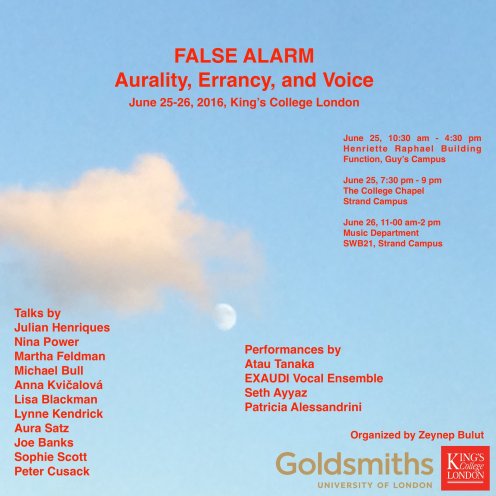
The next “Rorschach Audio” demonstration takes place as part of “False Alarm” – a symposium convened by Dr Zeynep Bulut at King’s College, London, 25 + 26 June 2016. “False Alarm” focusses on “the aurality and errancy of voice” and “forms of mishearing… creative, accidental or hallucinatory”. Speakers include Lynne Kendrick (CSSD), Martha Feldman (University of Chicago), Zeynep Bulut, Andy Fry, Matthew Head, Roger Parker & Heather Wiebe (KCL), Lisa Blackman & Julian Henriques (Goldsmiths), Peter Cusack (LCC), Anna Kvičalová (Max Planck Institute for the History of Science), Nina Power & Aura Satz (RCA), Joe Banks (artist and author of the book “Rorschach Audio”) and Sophie Scott (UCL). The “False Alarm” concert features Atau Tanaka, Seth Ayyaz, Patricia Alessandrini and the Exaudi Vocal Ensemble (performing music by Christopher Fox, James Weeks, Claudia Molitor and Zeynep Bulut). To purchase tickets please follow this link…
http://www.kcl.ac.uk/artshums/depts/music/eventrecords/2016/False-Alarm.aspx
Coincidentally the “Rorschach Audio” presentations at Monash University Museum of Art and Gertrude Contemporary [art gallery] (both Melbourne) were programmed to accompany the exhibition “Believe not every spirit, but try the spirits” by the Victorian Spiritualist painter Georgiana Houghton, at MUMA in June 2015, and the Georgiana Houghton exhibition re-opens at the Courtauld Institute (next door to KCL) next week. Particularly in relation to the forensic aspects of the “Rorschach Audio” project, it is interesting that one subject which seems to have been overlooked by most discussions of Georgiana Houghton’s painting, is how she also seems to have been involved in the commercial exploitation of fraudulent spirit photography. In 1882 Georgiana Houghton published a book called “Chronicles of the Photographs of Spiritual Beings & Phenomena Invisible to the Material Eye”, which promoted photos by the fraudulent spirit photographer Frederick Hudson, featuring fake mediums such as Agnes Guppy-Volckman. In fact Fred Hudson’s forgeries were so bad they were exposed by other Spiritualists…
http://courtauld.ac.uk/gallery/what-on/exhibitions-displays/georgiana-houghton-spirit-drawings
https://en.wikipedia.org/wiki/Frederick_Hudson_(photographer)
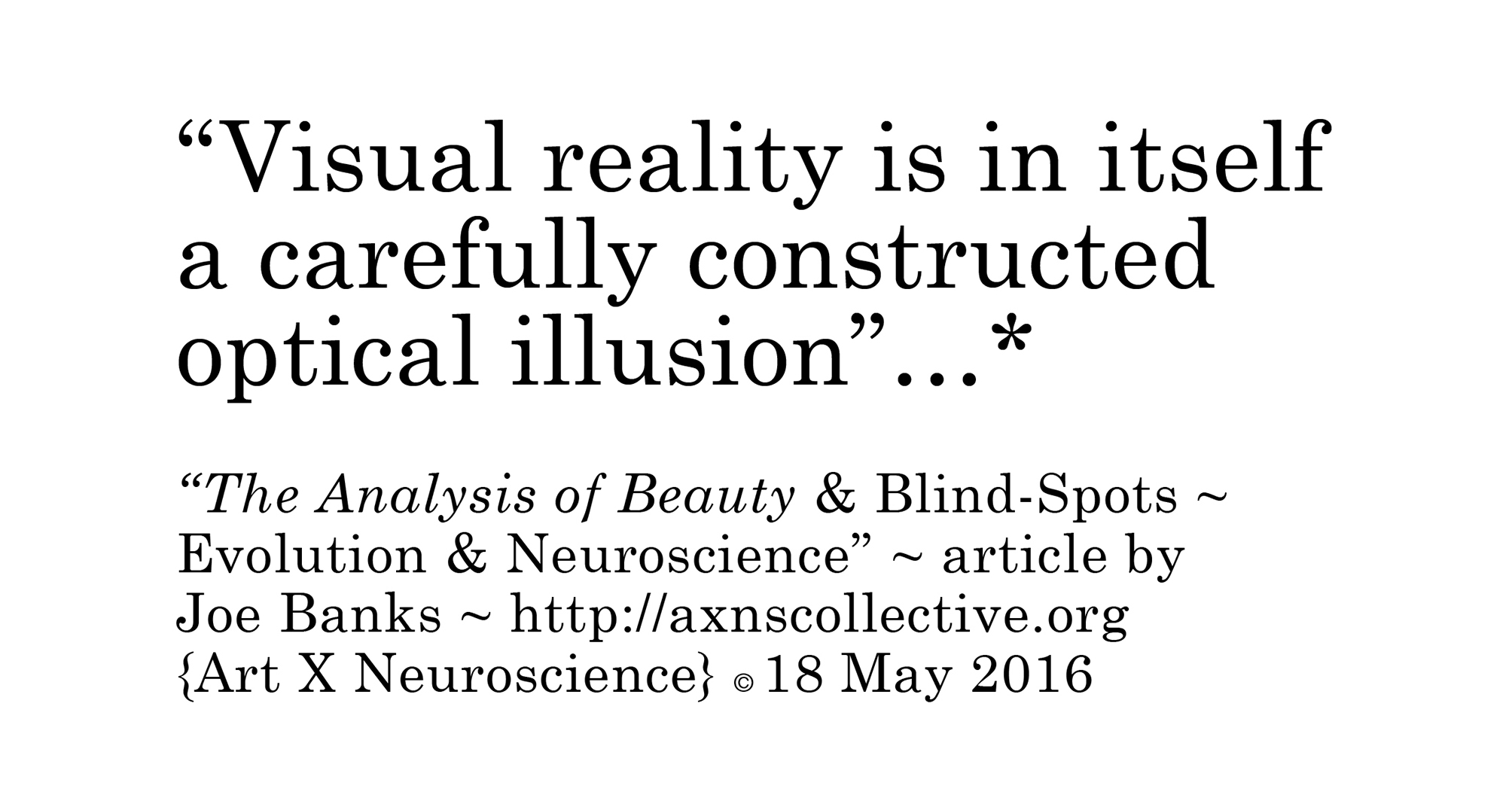
AXNS Collective – Arts X Neuroscience – just published an article on “The Analysis of Beauty & Blind Spots – Evolution & Neuroscience”. The article revisits some ideas, which are discussed in the “Rorschach Audio” book and on this website, in context however of material which includes passages on opthalmic neuroscience quoted from Aldous Huxley. The article places discussion of “The Analysis of Beauty” in context of a broader argument about how certain types of perceptual phenomena demonstrate the extent to which “visual reality is in itself a carefully constructed optical illusion”, being very careful to stress however that such illusions “usually provide accurate descriptions of our external world”. In addition, the suggestion that the mind might also be able to “switch off” visual objects (which exist right there in front of us) may also seem counterintuitive, however the article responds to William Hogarth’s assertion that “the eye may be subdued and forced into forming and disposing of objects even quite contrary to what it would naturally see them, by the prejudgment of the mind” (emphases added) by showing how the mind can and does “edit” whole objects into and out of visual perception as a matter of routine…
For reasons of space, it wasn’t possible to include all the quotes from Aldous Huxley in the article for AXNS, so, in context of this website, it’s helpful to add some more detail. In his book “The Art of Seeing” Aldous Huxley states that “sensing is not the same as perceiving” and that “the eyes and nervous system do the sensing, the mind does the perceiving”. Huxley describes how “in adults, the three processes of sensing, selecting and perceiving are for all intents and purposes simultaneous”, with the effect that under normal circumstances “we are only aware of the total process of seeing objects and not of the subsidiary processes which culminate in seeing”. Huxley goes on to describe how “by inhibiting the activity of the interpreting mind”, it is however possible to “catch a hint of the raw sensum [sense data] as it presents itself to the eyes of the newborn child”, and how “for the adult, a complete recapture of the experience of pure sensation, without perception of physical objects, is possible, in most cases, only in certain abnormal conditions, when the upper levels of the mind have been put out of action by drugs or disease”.
Aldous Huxley describes “an experience of my own”, recalling how “coming out of an anaesthetic administered in a dentist’s chair” produced the effect that “returning awareness began with pure visual sensations completely devoid of significance”. These sensations “were not objects existing ‘out there’ in the familiar, three-dimensional world”, but were “just coloured patches, existing in and for themselves, unrelated not only to the external world, but also to myself – for the knowledge of self was still wholly lacking, and these meaningless and unattached sense impressions were not mine, they simply were.” As the anaesthetic wore off these coloured patches became “associated with certain objects ‘out there’ in the external three-dimensional world”, and Huxley goes on to describe how his mind progressively identified and categorised these objects, increasingly relating them to his own memories and to his re-emerging sense of self. Then, perhaps most revealingly, Huxley describes how these thought-processes themselves led to “further clarification of vision”.
Now, I’m aware that there’s some controversy about some of the content in “The Art of Seeing”, however that relates to debate about the efficacy of specific therapeutic procedures advocated by Huxley, and not to his insights into psychology of perception. It should also be stressed that studies of illusions also provide very powerful tools for studying perception.
Source – Aldous Huxley “The Art of Seeing” Chatto & Windus 1943
With apologies for not posting about this earlier, thanks to everyone who came to an excellent night at the Horse Hospital in Bloomsbury, London, 2 June 2016. “Music Concrète: of the Building Outside the Building” was “a collaborative night of joyful experimental sound art and performance (created) using recorded sounds and sonically manipulated environmental data from Senate House Library”. The source material was recorded by Senate House artist-in-residence Hannah Thompson, and the evening featured sets by Paul Middleton & Daniel Knowler, Medial Ages, Isn’tses, Aatschlag, Raxil4, Orlando Harrison, Disinformation, and a particularly memorable contribution by real-life beekeeper Bioni Samp (with GPUD not performing owing to commitments at Senate House). Among other sound elements, the Disinformation performance showcased recent “Rorschach Audio” themed experiments, created using speech synthesis and vocoded speech recordings…
Rorschach Audio classics – The Two Ronnies “Four Candles”
https://rorschachaudio.com/2014/06/19/two-ronnies-deaf-in-the-trenches/
“Speech itself is an art form” – http://tinyurl.com/hfrdowt

The new edition of “The Psychologist” magazine includes a “Rorschach Audio” article, discussing psychoacoustics, bereavement and the public understanding of science. First paragraph as follows… “The August 2015 issue of Harper’s Bazaar magazine carries a two-page feature entitled ‘On the Discovery of Hope’ by the magazine’s editor-in-chief Justine Picardie – a writer who also found fame and influence as a journalist and the best-selling biographer of Coco Chanel. The article came shortly after last summer’s re-issue of Justine’s earlier book ‘If the Spirit Moves You’, which recalls, in moving detail, her experience of bereavement after the loss of a close family member. ‘On the Discovery of Hope’ is a thoughtful and well-written meditation on the experiences that were described in Justine’s earlier work, but what’s perhaps most striking is the fact that not once does this article mention the huge emphasis that ‘If the Spirit Moves You’ places on its author’s involvement with spiritualist mediums and with so-called Electronic Voice Phenomena recording…”
The magazine also contains contributions from (among many others) Yeni Adewoye, Ben Alderson-Day, Alexander Bridger, Fleur-Michelle Coiffait, Anna Cox, Ron Davie, Emma Davies, Andrew Dunn, Naoimh Fox, Daniel Jolley, Joanna Moncrieff, Anna Sallis, Shalini Raman, Lance Workman and the artist Kerry Tribe.
https://www.bps.org.uk/psychologist/rorschach-audio-art-and-illusion-sound
NB – the online version of Justine Picardie’s piece for Harper’s Bazaar slightly modifies the title of her original print article…
http://www.harpersbazaar.com/uk/beauty/fitness-wellbeing/a35011/how-to-be-happy/

On the 3 March 2016 a “Rorschach Audio” lecture demonstration was presented at The University of Applied Sciences & Arts (FHNW) Basel as part of “The Sensorium of Animals” – a two day symposium convened and organised by Shintaro Miyazaki (of the group Detektors) and the artist Susanna Hertrich. “The Sensorium of Animals” took place at The Institute of Experimental Design & Media Cultures (IXDM) at FHNW (which, as it happens, is right next door to Basel’s House of Electronic Arts, the HeK). The symposium was convened to explore “electroreception in experimental and historical media and design research”, and to explore “the possibilities of technology mediated systems to alter the human sensory apparatus from artistic-experimental and media historical angles”. Contributors included Jamie Allen, Alvaro Cassinelli, Joe Banks, Gerhard von der Emde, Antony Hall, Michael Hohl, Martin Howse, Pedro Lopes, Barbara Nordhjem, Selena Savic, Daniela Silvestrin, Tom Thwaites and Jan Claas van Treeck. Among a series of very interesting presentations, particular high-points included talks by Gerhard von der Emde (University of Bonn) and the sound artist Anthony Hall (Owl Project), both speaking about the sensory capabilities of (some extremely cute) electric fish; and the events were followed by excellent (albeit separately organised) noise performances by (turntablist) Pedro Lopes and (guitarist) Mikko Savela, at Plattfon + Stampa.
The following day included a presentation about the Disinformation project, focussing on the “R&D” CD, and “National Grid” and “Stargate” sound works (which were all published in 1996, using electromagnetic – shortwave and VLF radio – noise from natural and man-made sources, including electromagnetic noise from live mains electricity and from the sun), and this presentation provided an invaluable opportunity to fly the flag for Disinformation’s artistic research into electromagnetic fields, etc. Special thanks to Susanna Hertrich, Shintaro Miyazaki, Martina Siegwolf and Zata Banks. Thanks also to everyone who heard “Stargate” at the Upplýsingafölsun Hlustunarpartý in Reykjavik on March 10, and everyone who came along to the impromptu “Rorschach Audio” event at NES Skagaströnd on Feb 18.
Photo – Umberto Eco with Renate Ramge
“Semiotics is in principle the discipline studying everything which can be used in order to lie. If something cannot be used to tell a lie, conversely it cannot be used to tell the truth: it cannot in fact be used “to tell” at all.” [ex caelis oblatus, 1932]
https://en.wikipedia.org/wiki/Strange_loop
https://en.wikipedia.org/wiki/Liar_paradox


