A Spectre, A Spectre - Haunting, Aaron Mahnke, Acoustic Anthropology, Acoustic Illusion, After Post-Truth, Albert Bregman, Ambiguity, Antonis Antoniou, Apollonius of Perga, Archive 81, Archive81, Artist, Audio Apophenia, Audio Forensics, Audio Illusion, Audio Rorschach, Auditory Ambiguity, Auditory Apophenia, Auditory Pareidolia, Aural Auras, Aural Auras and Haunting Echoes, Aural History, Be Language, Binocular Inversion, Black Tapes, Black Tapes Podcast, Brain, Camera Obscura, Centre for Chinese Contemporary Art, Centre for the Study of the Senses, CFCCA Manchester, China Mieville, Cognition, Cognitive Science, Culture, Daniel Powell, Dead Signals, Dead Signals Podcast, Design, Diana Deutsch, Digicult, Digital Art, Disembodied Voice, Disinformation, Disinformation Network, Dr Eleonora Oreggia, Earwitness Testimony, Electronic Voice Phenomena, Elena Biserna, Eleonora Oreggia, EVP, Eye Tracking, Forensic Audio, Furtherfield, Gareth Evans, Goldsmiths College, Haunting, Haunting Echoes, Hearing Lips & Seeing Voices, Human Eye, Illusion of Sound, Illusions, Joe Banks, Language Analysis, Left of the Dial, Left of the Dial Podcast, Let There, Let There Be, Let There be Language, Locus Sonus, Lore, Lore Podcast, Lucida, Marc Sollinger, Marius Kwint, Marseilles, McGurk Effect, Media, Misinformation, Misinformation Network, Netflix, Network, Nkisi, Optical Illusion, Oto Projects, Paracoustics, Paranormal Acoustics, Paréidolie, Paul Bae, Perceptual Hypotheses, Perceptual Psychology, Phantasmata, Phantasmata and Illusions, Post Theory, Post Theory Art, Post-Truth, Psychoacoustics, Reality, Rhizome, Richard Wingate, Rorschach Audio, Rorschach Sound, Sarah Hayden, Séance, Séance: Technology of the Spirit, Sine-Wave Speech, Sonic Phantoms, Sonic Phenomena, Sonic Research, Sonic Studies, Sonorama, Sound Art UK, Sound Artist, Sound Arts UK, Sound Escapes, Sound Studies, Spectre, Spectre Haunting, Speech Muse, Speech Muse Fest, Speech Muse Festival, Spirit Technology, Static Man, Stone Tape, Stone Tape Theory, Suki Chan, Technologies of the Soul, Technology of the Soul, Technology of the Spirit, Terry Miles, The Black Tapes, The Black Tapes Podcast, The Static Man, The Voice in Art, There Be Language, Tintype Gallery, UCL Discovery, University of Salford Art Collection, V&A Late, V&A London, Victoria & Albert Museum, Vision, Visual Perception, Visual Reality, Visual reality is in itself a carefully constructed optical illusion, Vocal Phantoms, Voice Art, Voice in Art, Wellcome Trust, Xname
“Rorschach Audio” quoted on Apollonius of Perga
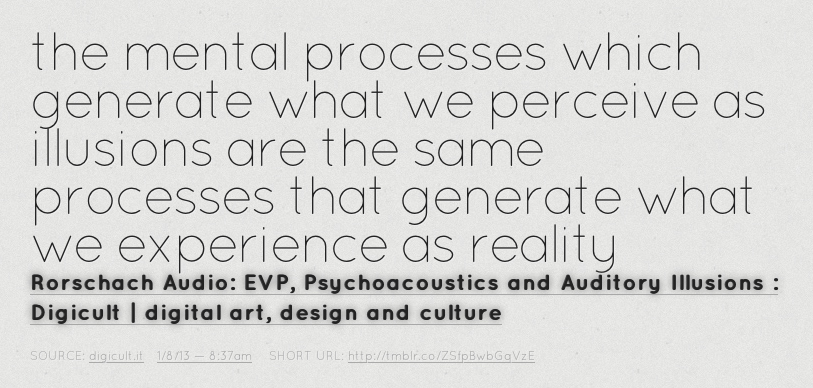
Graphic from the Apollonius of Perga website –
http://www.apolloniusofperga.tumblr.com
Quoting from the Digicult article – tinyurl.com/48y5zsdh
Related
From → Uncategorized
 Disinformation + Rorschach Audio
Hello Joe,
I’ve very nearly finished reading your Rorschach Audio book (just a couple of pages left to go), and have thoroughly enjoyed it. It’s strongly written, with a good balance between graceful text and incisive criticism. Please forgive this slightly lengthy comment in what might not be the most appropriate place, but I couldn’t find any other way to contact you.
Earlier today, a small event reminded me of an auditory illusion that I have experienced before, but which I have yet to discover any documented discussion about. I thought you might like to hear of it, and wondered whether it’s something you’ve come across before, as I’ve not read about it in your book or on this site:
At my workplace this afternoon, which became very quiet when the air conditioning was turned off after the plumber fixed the boiler, a colleague asked whether I could also hear a persistent rhythmic noise. I could hear it too, but we couldn’t work out where it was coming from, nor whether it was a small sound of a dripping tap or the louder sound of a dog barking or an electronic bleep coming from outside. It turned out to be the tap dripping into a mug, but the point is that this illusion is equivalent to a visual mis-perception, beautifully recounted in a scene from Father Ted, where it is explained to Father Dougal that “these [cows] are small, but the ones out there are far away.” One notable difference (in my experience) is that in the visual illusion the alternate perceptions are usually only reduced in scale, whereas in the auditory illusion sounds can be interpreted as being completely different things. I would put this down to our capacity to interpret sounds depending on the way in which they are modified over a distance – i.e. by physical barriers, audio reflections/interferences, filtering through air, etc. – with the result that the same sound produces widely differing hypotheses about its source. I have experienced this effect mainly upon waking or going to sleep (situations in which suggestibility is increased, I assume), and have mistaken tiny, close rustles or creaks within my bedroom for loud knocks and bangs coming from outside the house.
Is this something you are familiar with? Would you agree with my explanation of this illusion? Are you able to shed any more light on this phenomenon? (Apologies for the visual metaphor!)
Regards,
Guy
Thanks for the comment Guy, you’re welcome. The Father Ted / Father Dougal joke is a classic, sometimes more chilling than funny when you think that with some illusions of sound there are people who actually think like this!
Having grown up in creaky houses the kind of sounds you’re describing are all too familiar, and can be scary enough without any strong superstitious beliefs – bear in mind that (in terms of the Sapir-Whorf hypothesis) I’m pretty sure the language of describing misunderstood sounds in terms of words like “illusion” has only been available to most people for a few hundred years, so if you rewind to a time before electric lighting, when strong religious beliefs and superstitions seem to have been the norm, when many people had never seen even an illustration of an optical illusion, let alone a demonstration of an audio illusion, it’s easy to see how these kinds of experiences can take on a life of their own, so-to-speak.
There are some really cool illusions of just the sort you describe as well, it’ll be a while before I write those up however cause I’m saving those for future publications.
Thanks for the reply, Joe. Good point about the evolution of language and belief systems making it hard to track the phenomenon via today’s concepts/terms (though my view, contrary to the principle of linguistic relativity, is that sensory perception is more primal than language in cognitive development). I’ve finished the book now. Looking forward to reading your future publications.
You’re right some forms of perception are definitely more primal than language, however, while I’m no expert in… fire prevention engineering*, I doubt that fact’s contrary to the principle of linguistic relativity. Then again, what the hell do Klingons know about linguistic anthropology (hell, there’s a joke in there somewhere – a Simpsons sketch about an anthropologist called Benjamin Lee Worf)?!
* http://en.wikipedia.org/wiki/Benjamin_Lee_Whorf
Next publication – a magazine article – should be out (fingers crossed) pretty soon
It’s difficult to understand exactly what is being claimed in linguistic relativity – the subject is vast, its claims come in many different strengths and varieties, and as noted elsewhere “the primary literature is in any case more often polemical than enlightening”. There’s probably an Ig Nobel prize to be had from research into testing the validity of the Sapir-Worf hypothesis in the Klingon language… “Whorf meets Worf: the linguistic relativity of Klingon” :¬)
Linguistic relativity seems to be one of those theories that contains alot of truth, but which can, for its opponents, be “disproved” by… taking the basic ideas to ridiculous extremes. Core idea/s of linguistic relativity seem to mutually confirm findings of cognitive psychology, and vice versa, ie – the idea that at least in some cases we can’t fully perceive an object until its been semantically defined; however to be honest some of the appeal of referencing this theory came from the sheer eccentricity of the characters concerned – the Rorschach Audio book tries to tell a good story, albeit factual (for anyone else who reads this, see Wikipedia link, above, for details).
As I’m sure you noticed, a bit like when film editors jump from one scene to another at the point where the whistling kettle that ends the 1st scene sounds like the steam-train that opens the 2nd, the book makes use of a narrative device, warehouse fires – Whorf – segue into a warehouse robbery – the Craig & Bentley shooting – a case in which disagreement about an alleged perceptual ambiguity changed legal history, IMHO for the better, I’m pleased to add