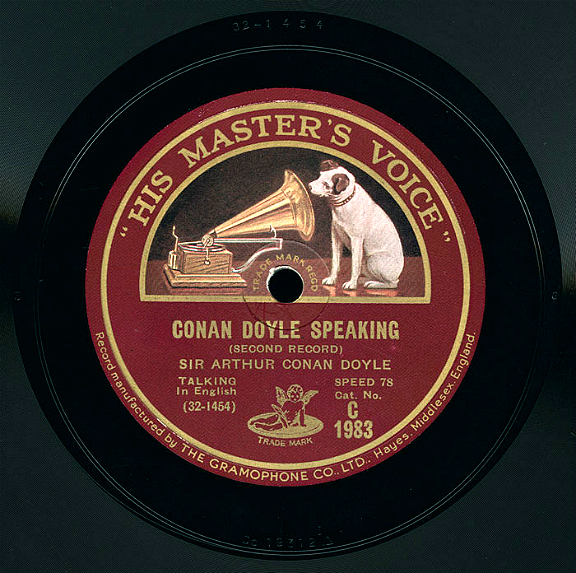
Article by Stephen Cleary, Lead Curator of Drama & Literature at The British Library (photo credit – The British Library)…
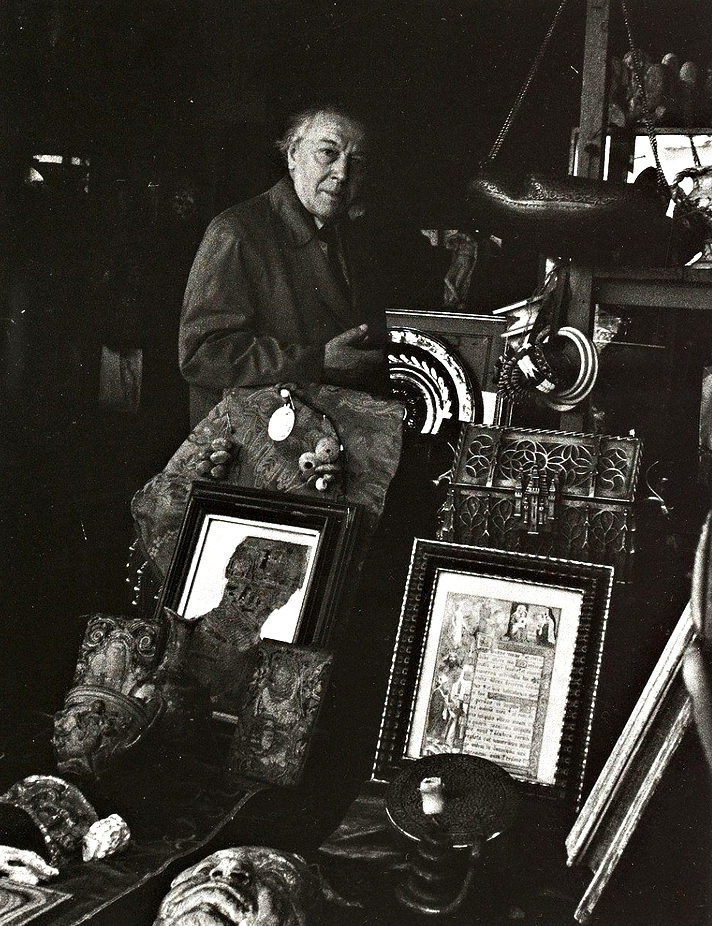

Tues 8 April 2014, 7.00pm
Café Scientifique
Oxford University Museum of Natural History
Parks Road
Oxford OX1 3PW
http://www.rowingservice.com/cafescientifique/oxford/audio.html
Anyone who saw Christina Kubisch’s “Electrical Walks” in Oxford, check this out –
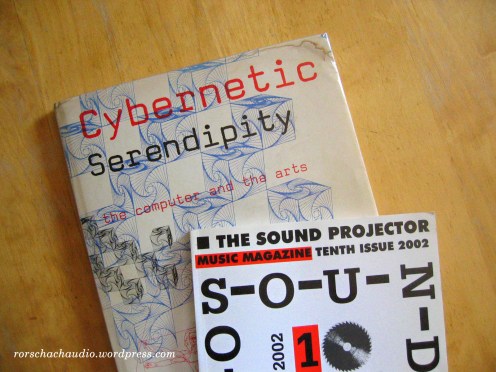
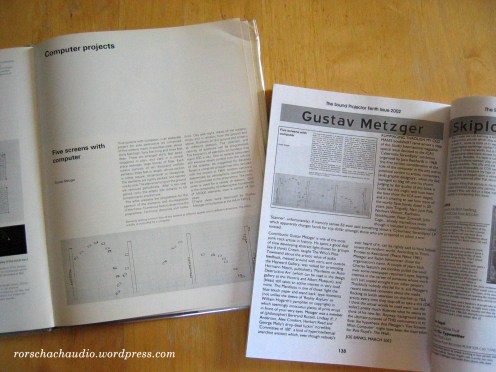
In March 2002 I wrote an opinion piece for “Sound Projector” magazine (issue 10, page 138, published May 2002), which was largely inspired by a cache of documents that had come to light among my dad’s possessions – a book and information sheets relating to the “Cybernetic Serendipity” exhibition at The Institute of Contemporary Arts, and catalogues of the “Anti-University of London”. The Anti-University documents are discussed in an earlier post (see below), and all are striking, not least on account of the involvement of auto-destructive art pioneer and peace activist Gustav Metzger. Gustav Metzger was a founder member of the campaign group The Committee of 100, alongside Stuart Hall (see earlier posts); to get to the point however, in the “Sound Projector” article I speculated – and do please remember where you read this first – that Gustav Metzger’s work “Five Screens With Computer” may well have inspired the central motif in Pink Floyd’s album, film and stage-production “The Wall”.
In 1968 Studio International published 2 printings of a special magazine dedicated to the “Cybernetic Serendipity” exhibition – the “first serious consideration of the role of the computer in the arts, and its potential service to artists, composers (and) graphic designers” – which had been organised by Jasia Reichardt, in collaboration with Mark Dowson, Peter Schmidt and Franciszka Themerson, and held at The ICA earlier in 1968. Although technically a magazine, the 2nd printing is a large-format hardback book, and Studio International’s “Cybernetic Serendipity” book contains an article by Gustav Metzger, describing a talk he gave at the Architectural Association in 1965, which in turn described his proposal for an enormous public art project called “Five Screens With Computer”.
As described, “Five Screens With Computer” is “an elaborate project for auto-destructive art composed of five screens made of stainless steel, about thirty feet high, forty feet long and three feet deep. These are arranged thirty feet apart, staggered in plan, and sited in a central place between large blocks of flats. Each screen consists of ten thousand uniform elements three feet in length, whose section is either square, rectangular or hexagonal. The elements are tightly packed, and ejected one by one… After a ten-year period, the site remains to be turned-over to another use. The artist prepares the (computer) programme for the ejection of the elements.” If it wasn’t already obvious from that description, the diagram in Studio International depicts “Five Screens With Computer” (in profile) as a series of walls constructed from rectangular building-blocks, which fall out onto the ground in varying sequences. Understanding the word “screens” to refer here to walls, and “elements” to refer to component building-blocks, with those building-blocks tightly stacked-up in and ejected from a steel shelving system, the similarity with “The Wall” by Pink Floyd seems self-evident. The question remains as to whether (or to what extent) the similarity might have been coincidental? The Studio International article states “these ideas were discussed by Gustav Metzger in his lecture at the AA in 1965”.
As it happens, in terms of background, it seems Pink Floyd formed some time after members Roger Waters, Nick Mason and Richard Wright met, while studying Architecture at The London Polytechnic in Regent Street (now the University of Westminster), not far from the Architectural Association, around 1962-3 [1]. Now, by comparison, it’s well-known that Gustav Metzger introduced The Who guitarist Pete Townshend to the concept of using destruction (the deliberate smashing of guitars and drums etc) and audio feedback as artistic elements, when Townshend attended Metzger’s lectures at Ealing Art College; Pete Townshend freely acknowledges that influence, and sponsored Metzger’s exhibition at Modern Art (formerly Moma) in Oxford in 1998. Likewise (I am indebted to Bronac Ferran for pointing-out that) Syd Barrett biographer Julian Palacios states that “Roger Waters and Rick Wright shared a flat with Hornsey (College of Art) students (Peter) Dockley and Pete Kuttner” [2] (themselves fascinating artists); Dockley recalled that “while Pete Kuttner and I were at Hornsey, Gustav Metzger gave a lecture-demonstration in the main hall of the college. Metzger used ink suspended in an oil base, housed between glass small enough to insert into a projector that used two-by-two inch slides. The lecture was completely enthralling. Suddenly, these miniature-scale coloured ink events and interactions were blown-up fifteen foot square. I turned to the back and there were (Roger) Waters and (Rick) Wright, soaking up Gustav’s performance. They went to speak with him afterwards, and to look in more detail at his equipment. Artist Mark Boyle was also using similar projections, so it was in the air. I like to think Gustav, a brilliant artist but very unassuming man, was in part responsible for a chief component of the psychedelic experience.” Nick Mason himself is quoted as stating that in 1963 he and Roger Waters lived in a flat owned by architect and light artist Mike Leonard – Leonard also being a tutor at Hornsey and at the Regent Street Poly [3]. Pink Floyd were filmed performing in Mike Leonard’s house for the BBC TV science programme Tomorrow’s World [4], Peter Dockley himself went on to collaborate directly with Pink Floyd [5], and Pink Floyd recorded an (as yet unreleased) soundtrack for the film “Speak” by art-science pioneer John Latham [6], who (separately) collaborated with Gustav Metzger.
So, while this evidence does suggest that Pink Floyd seem to have moved in similar circles to Gustav Metzger, to have attended at least one Metzger lecture, and to have personally questioned Metzger about aspects of his art, what’s most important here is that the sets for Pink Floyd’s “The Wall” were designed by architect Mark Fisher [7]. In addition to the fact that, by the time of the conceptual genesis of “The Wall” in the late 1970s, Metzger’s proposal for “Five Screens With Computer” had (as published by Studio International) been readily publicly available for years anyway, The Guardian also confirms that Mark Fisher “began his studies at the Architectural Association in London in 1965” [8] – the same year that Metzger presented his original proposal for “Five Screens With Computer” at the Architectural Association (and Mark Fisher also worked as a Unit Master at the AA School until 1977).
By any standards “The Wall” is an enormously impressive and powerful piece of work, and, what you might call the official version of the genesis of “The Wall” concept, seems to suggest that, reflecting the increasingly distant relationship between mainstream (ie – stadium) rock performers and their audiences (that, as it happens, strongly influenced the emergence of punk) Roger Waters developed the imagery of “The Wall” as a metaphor for his alienation from over-adoring music fans and from figures of social and political authority. In fact the music in “The Wall” moves away from Pink Floyd’s psychedelic roots towards, in places, almost disco influences, and, in terms of lyrics, the politics of punk. So, while it’s beyond question that there’s a huge amount more to “The Wall” than just that one main visual image, however it’s also true that the official version and the hypothesis posited here aren’t mutually-exclusive. Finally, for those artists, curators, historians, journalists and bloggers etc who might wish to repeat or discuss the idea that “Five Screens With Computer” may have influenced “The Wall”, please be sure to acknowledge my articles on this as your source (and, if any reader has information that sheds more light on this, please do get in touch).
[1] Glen Povey “Echoes: The Complete History of Pink Floyd” 3C Publishing 2008
[2] Julian Palacios “Syd Barrett & Pink Floyd – Dark Globe” Plexus 2010
[3] Nick Mason & Philip Dodd “Inside Out – A Personal History of Pink Floyd” Phoenix 2004
[4] https://www.youtube.com/watch?v=kg84zCmEYhc
[5] http://www.arnolfini.org.uk/people/dockley-peter
[6] http://www.sydbarrettpinkfloyd.com/2009/06/lost-syd-barrett-and-pink-floyd.html
[7] Vernon Fitch & Richard Mahon “Comfortably Numb: A History of The Wall” PFA 2006
[8] http://www.theguardian.com/music/2013/jul/03/mark-fisher
http://www.thesoundprojector.com/
Thanks to Colin Banks & Bronac Ferran
Copyright © Joe Banks, 12 March 2014
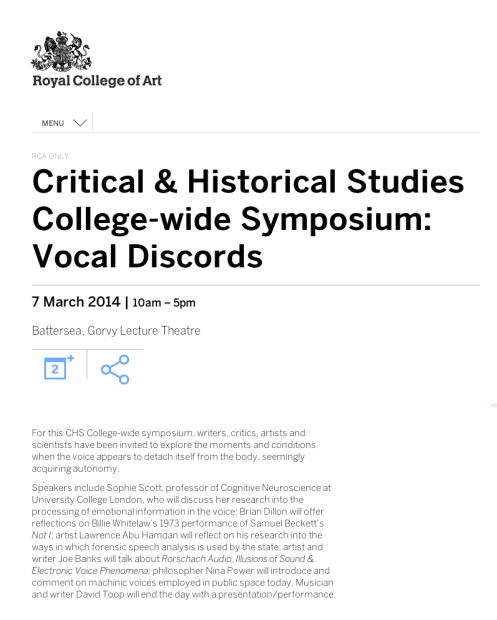
The “Vocal Discords” symposium at the Royal College of Art, London, 7 March 2014, featured a “Rorschach Audio” lecture-demonstration – including discussion of the dramatist John Dennis and illusions of thunder, see earlier post – alongside talks by Sophie Scott, Brian Dillon, Lawrence Abu Hamdan, Nina Power and David Toop.
Thanks to everyone who came along, and special thanks to David Crowley for the invitation!
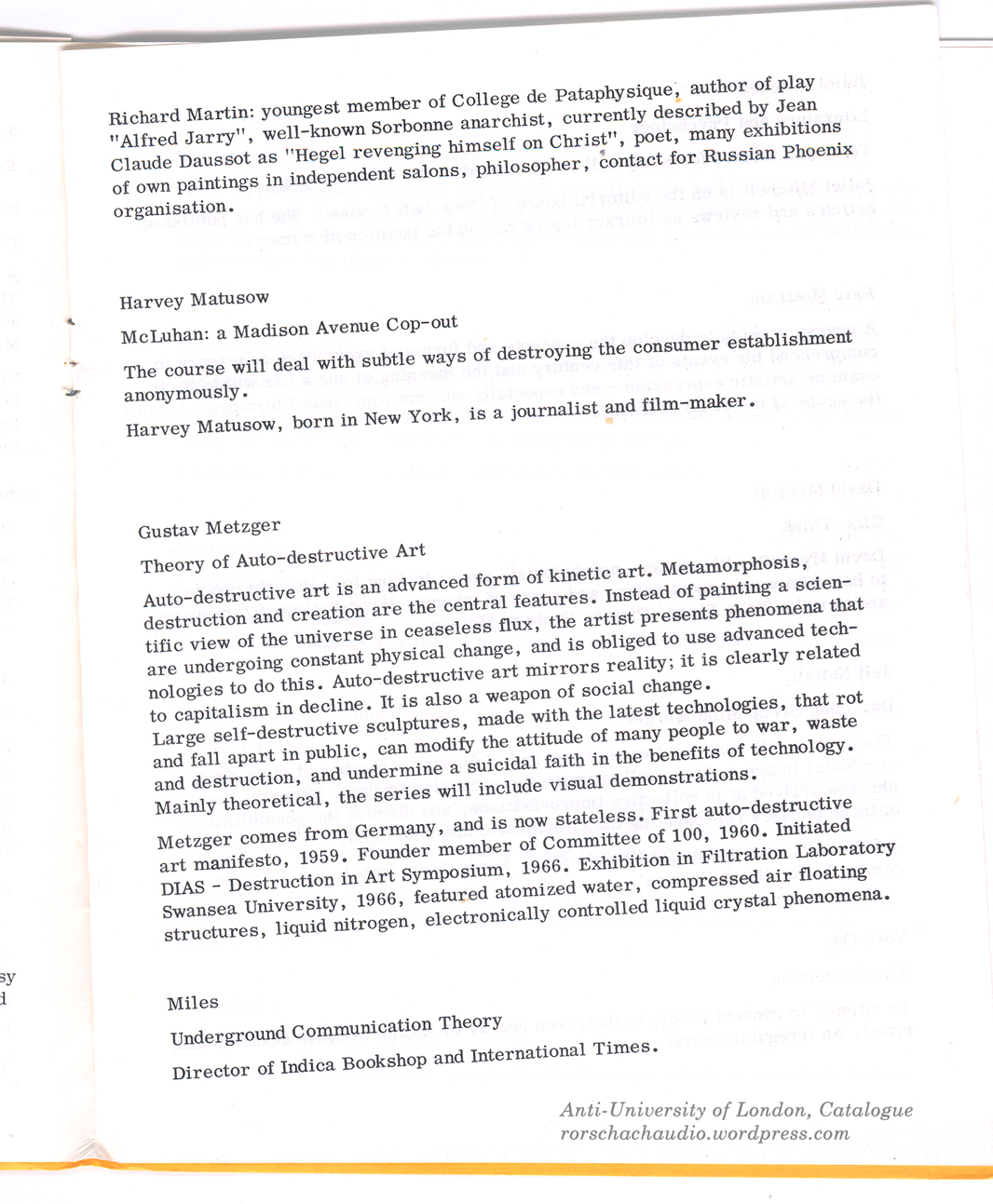
In March 2002 I wrote an opinion piece for “Sound Projector” magazine (issue 10, page 138, published May 2002), which was largely inspired by a cache of documents that had, to my surprise, come to light among my dad’s possessions – namely a book and information sheets relating to The ICA’s “Cybernetic Serendipity” exhibition, and 3 catalogues of the “Anti-University of London”, which opened in February 1968, more-or-less equidistant between the site of a much later, now much-lamented bar and art-space called The Foundry, on the corner of Old Street and Great Eastern Street, and Iniva’s Rivington Place gallery, just round the corner. As the first catalogue explained – “The Antiuniversity of London has been founded in response to the intellectual bankruptcy and spiritual emptiness of the educational establishment both in Britain and the rest of the Western World. It seeks to develop the concepts and forms of experience necessary to comprehend the events of this century and the meaning of one’s life within it, to examine artistic expression beyond the scope of the usual academy and to promote a position of social integrity and commitment from which scholars now stand aloof. The Antiuniversity of London of London will be a meeting ground for discussion, discovery, rediscovery and revelation. It is intended as an ongoing experiment in the development of consciousness and will be related to other revolutionary experiments in universities, communities, communes and direct action now taking place in Europe and America”.
If the words of that opening statement sound, by today’s standards, somewhat of-their-era, it’s sobering to note how many Antiuniversity lecturers were, or were to become, acknowledged as experts and even world-leaders in their fields. Among many others, “Psychology and Religion” was taught by the radical psychiatrist R.D. Laing. “Psychology and Politics” was taught by David Cooper. Courses were taught by “Black Jacobins” historian and cricket-nut C.L.R. James, by The ICA director Michael Kustow, and by art-science pioneer John Latham. Stuart Hall (see earlier post) is often primarily thought-of as having been a sociologist and cultural-theorist, however he was also an important communications theorist and peace campaigner, who went on to become the back-bone of that most socially-idealistic and pragmatic of institutions, The Open University. Visiting Faculty included William Burroughs, Hans Enzensberger, Allen Ginsberg, Adrian Henri and Carolee Schneemann.
The 2nd catalogue advertised Pop Art pioneer and former electrical draughtsman Richard Hamilton, as giving 2-hour lectures on the art of Marcel Duchamp, and International Times founder (now cultural historian) Barry Miles as lecturing on “Underground communications theory”, and Yoko Ono as lecturing on “The Connection” (reserving however “the right to interview and choose a limited number of students before the session begins”). In relation to the general subject matter of the “Rorschach Audio” project, it’s also interesting to note the 3rd catalogue advertised (medical doctor and peace activist) Rachel Pinney as offering courses in “Creative Listening”. John Keys was lecturing on… (one word)… “Everything”!
Of particular interest here however was the involvement of the artist and campaigner Gustav Metzger, who I’d briefly met through mutual association with gallerist David Clegg, when David curated the first Disinformation sound-installation into the “Sound Proofs” exhibition at The Museum of Installation gallery in London in July 1997. I was extremely grateful for the abrupt but very encouraging comments Gustav made about my work, and (particularly in light of the self-annihilating and nuclear-flash related imagery produced by the Disinformation exhibit “The Origin of Painting”) was then stunned to read the Antiuniversity catalogue entry describing Gustav Metzger’s talks. “Auto-destructive art is an advanced form of kinetic art. Metamorphosis, destruction and creation are the central features. Instead of painting a scientific view of the universe in ceaseless flux, the artist presents phenomena that are undergoing constant physical change, and is obliged to use advanced technologies to do this. Auto-destructive art mirrors reality; it is clearly related to capitalism in decline. It is also a weapon of social change. Large self-destructive sculptures, made with the latest technologies, that rot and fall apart in public, can modify the attitude of many people to war, waste and destruction, and undermine a suicidal faith in the benefits of technology”. A biography adds “Metzger comes from Germany, and is now stateless. First auto-destructive art manifesto, 1959. Founder member of Committee of 100, 1960. Initiated DIAS – Destruction in Art Symposium, 1966. Exhibition in Filtration Laboratory Swansea University, 1966, featured atomized water, compressed air floating structures, liquid nitrogen, electronically controlled liquid crystal phenomena.”
Special thanks to Colin Banks
Joe Banks, 26 Feb 2014
Gustav Metzger, myself and Stewart Home were interviewed on Resonance FM, 24 Feb 2003 – http://www.youarehear.co.uk/shows.html (scroll down through page)

The next “Rorschach Audio” presentation takes place at Argos (centre for art and media), Brussels, Thurs 13 Feb 2014, organised as a co-production with the sonic arts organisation Overtoon. The talk coincides with the exhibition “Written on Tablets of Flesh” by Erik Bünger (who participated in the EVP event at The Liverpool Biennale in 2012). In addition to the comparison between perceptions of ambiguous sounds and Rorschach ink-blot tests, and in order to further demonstrate links between ideas about sound recording, the role of “perceptual hypotheses” in audio perception, and equivalent mechanisms of visual perception, this talk also focuses on the Kinetic Depth Effect illusions created by “The Analysis of Beauty” video installation (most recently screened at the Rio Cinema in Dalston on 9 Nov 2013).
Thurs 13 Feb 2014 at 7.30pm
Argos [centre for art and media]
Werfstraat 13 rue du Chantier
1000 Brussels
Belgium
Special thanks to Aernoudt Jacobs for the invitation. Belated thanks to Resonance FM for plugging this website on Facebook!
As one illustration of the role that forms of perceptual creativity, including creative mishearings, can play in specifically artistic creativity, the “Rorschach Audio” book speculates on the influence that Japanese author Hirai Tarõ’s choice of the pen-name Edogawa Rampo (aka Ranpo) – phonetically “Edgar Allan Poe” – may have had on the author Kimitake Hiraoka’s choice of the pen-name Yukio Mishima (refer to page 130 of the book for the full explanation). As the book says (and as depicted elsewhere on this website) Rampo and Mishima certainly met. In fact, albeit after Rampo’s death, Mishima wrote the screenplay for (“Battle Royale” director) Kinji Fukasaku’s movie “Black Lizard”, which is based on Rampo’s story of the same name. Mishima also appears in the film, playing a taxidermic human exhibit in the Black Lizard character’s art museum, and, in real life, Mishima was (at that time) romantically involved with the drag queen and social activist Akihiro Miwa, who plays the lead role in “Black Lizard” (and who’s still working, voicing characters in “Princess Mononoke” and “Howl’s Moving Castle” and regularly lambasting Japanese politicians on TV chat-shows, Miwa’s recordings “Yoitomake no Uta” and “Me Que Me Que” are object-lessons in the politics of listening, and it’s interesting to contrast Miwa’s pioneering LGBT activism with Mishima’s descent into moronic and suicidally destructive Fascism).
However, in terms of what the “Rorschach Audio” book says about the superficially meaningless wartime radio messages, parodied by Jean Cocteau in his film “Orphée”, being designed to transmit illusions of meaninglessness, “Black Lizard” contains similar radio messages, which are striking not least in their similarity to the kind of messages EVP researchers hear in recordings of stray radio chatter. So, where the radio in “Orphée” describes how “just one glass of water lights up the world”, “silence moves faster when it’s going backwards” and “the black crepe of little windows is a real sunshine meal” etc (screenplay translated by Carol Martin-Sperry), the operator in “Black Lizard” transmits messages which describe how “monkeys adorn the cows with candles” and “the pomegranate’s rind is shattered” (DVD subtitles), while EVP researcher Konstantin Raudive’s book “Breakthrough” describes messages which relate how “our father, lilac again, here Pastor Diko” (“Breakthrough” page 92) and “let the pipe be, are you going to dance, stupid?” (page 139), etc.
Amusing as that all is, the flip-side of the socially-inclusive and democratic idealism inherent in the “Rorschach Audio” book’s argument that all perception is inherently creative, and that all of us are therefore (to greater or lesser extents) creative artists, is, first, since we’re all artists, there can be no special “artistic” defence for trying to con people, second the equally sobering truism that (paraphrasing Jean-Paul Sartre) anyone can write bad poetry, likewise anyone can make bad art. Further to that the main difference between the deliberately nonsensical messages depicted in “Black Lizard” and in “Orphée”, compared to those perceived by Raudive, is that the movie scripts were meant to be a send-up, whereas (on page 12) “Breakthrough” quotes Hans Bender as stating that that in importance EVP is “equal to nuclear physics”.
Copyright © Joe Banks, 8 January 2013
 Disinformation + Rorschach Audio